Asotin Cross Country is Nearly Here

I admit it - I'm excited that the Asotin cross country season is nearly here. This will be the first year that I don't have any children of my own on the team but I'll be helping out with the junior high squad again. Coaching the kids keeps me a touch younger and, at the junior high level, most of them run because they enjoy it - they haven't gotten to the stage where each race counts in some standing. They do still care, passionately, about how they do. My job, even part-time, is to help them reach for their limits.

emil_zatopek

The other job is to keep them injury-free. The Asotin cross country teams have been remarkable blessed to have some fine runners among the fine people and we hate to see one of them hurting. At the junior high level, we work to teach them how to run with as little harm to their joints and tissues, focusing on form and listening to their bodies.

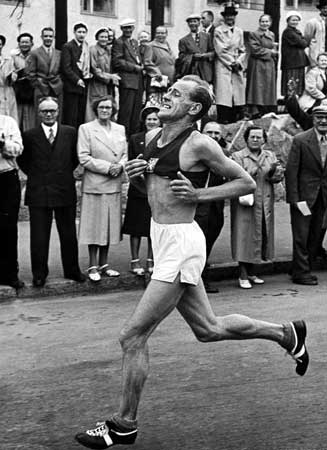
This year, I think I'll introduce them to Emil Zatopek, the great post WWII Czech runner - who had perhaps the worst form ever for a world record holder. Every picture I've seen of Zatopek makes him look as though he's just been kicked by a mule but, oh my, could the man run. At his peak, he held nine separate World Records.

Zatopek was a master of listening.

The message to the Asotin cross country kids is to not freak about form - you have to be true to your body. If you run best flopping an elbow, don't tuck it in. Listen. Your body will let you know when you have it right.

And when you have it right, you'll be faster and you'll be far less likely to be injured.


The Day Daisy Left

The day Daisy left the Shelter, everybody in the office cried but the tears were happy. People – and dogs, for that matter – leave shelters all the time. People because it is such hard work and emotionally challenging, the dogs because they leave for their forever homes. Daisy came into the shelter a stray during a brutal snap of winter, found wandering in the rural areas of Waha, a radio transmitter on her collar. We didn’t know how long she suffered exposure to the weather but it was long enough for the transmitter to go dead. Daisy was skin and bones.

A pointer experienced in working the fields (the radio collar was a giveaway), we waited for her owner to call. We hoped it would be soon. In the meantime, we combed our lost-and-found records to see if someone reported her as missing.

Nothing in the records.

And no phone calls from an owner frantic to find her.

Daisy went up for adoption a week later. Before we adopt our dogs, we always test them for temperament. Daisy was an oasis of calmness and completely unflappable. She simply didn’t take offense when you took away the food bowl and, when tested for dog aggression, just looked at the test dog as if to say, “Shush, youngster, don’t you fret.” Daisy was an older dog, about ten, and as easy-going as a grandma bringing cookies and lemonade to the little ones.

Daisy possessed such a kind heart that we expected that she would be adopted quickly. We were wrong. A sad secret is that most people don’t want old dogs, not even kind hearted ones. They want puppies, young scampering bundles of energy that will entertain them. Old dogs need more care and adopters worry about getting attached and then watching their newest family member fade too soon. So old dogs wait, patiently, a bit longer for their forever home.

Daisy possessed another flaw, one that puzzled us. She was always agreeable and friendly but she didn’t show well. All the dogs flood to the front of the kennels (we have outdoor kennels for our animals so they can enjoy the sunshine on nice days) when cars pull into our gravel parking lot. Daisy rushed forward too, and watched the people exiting the vehicles.

And always went to the back of her kennel as though she were hiding.

We thought that perhaps she had been abused at some time because she retreated faster if she saw men getting out wearing baseball caps. Dogs will react to visual clues just as people will. If men with sunglasses hit the dog, the dog will learn to fear men with sunglasses.

A week passed with no changes and assessment time for the newer dogs arrived. We placed Daisy into service helping us. Her job was to simply stand quietly while the other dog ignored her, or sniffed her butt, or barked or growled at her. Occasionally, one will lunge – which is why there are always two technicians involved, first to keep themselves safe but also to keep the dogs safe.

Daisy was an immediate star and became our canine ‘greeter’, welcoming new pets to the shelter. Though she didn’t earn multi-million dollar contracts, she did get special treats as a reward. Her favorite was canned cat food.  “Gotta work first” became a command we used when she tugged the leash as if to tell us, “Hey, that cat food is just over there. I can smell it” and gazed at us with those big sad eyes. Daisy was a very bright girl and she understood when we gave the command. She dropped in next to the tech and she would go to ‘work’ – just standing around meeting new friends, from her perspective – and then it was treat time.

When she wasn’t working, Daisy kept our receptionists company, lying quietly behind the counter – if one of the receptionist happened to have a spare hand that needed to pet a dog, she was a willing volunteer.

Each week was the same and we found other opportunities for Daisy to help. And each week passed with her watching the cars come from the front of her kennel and watched them leave from the back. We didn’t understand why someone couldn’t see the loving old dear as we did but Daisy never reached the top of anyone’s adoptable list.

Daisy was with us eight months. That’s a long time for an old dog but, if no one else will give a good dog a forever home, then we stand in and say, “Here, be with us, for as long as you need.

The day she left us was average for early August. The sky was clear and the sun hot. The dogs, including Daisy, were outside in kennels, most sitting in the shaded areas or lapping water from their bowls. Cars came in, cars left, Daisy walked forward, Daisy retreated.

I was outside watering the dogs when I heard the truck crunching across the gravel, park and the big diesel shut down. Daisy came to the front of the kennel as two young boys and a tall, lean man with a blue ball cap climbed down from the truck. Her nose pushed against the fence and waited for the retreat. Instead, she sat, a pretty, picture perfect sit/stay.

I looked her, stunned, and then to the family of men headed to the front door of the Shelter. I dropped the hose and sprayer and hurriedly strode towards them. Halfway across the parking lot, one of the boys, maybe 11, maybe 12, saw me. His eyes slid past me to the kennel and his eyes got very wide.

“Dad,” he said, pulling on the man’s left hand and pointing past me as I approached.

He looked, turned and said to me in a puzzled voice, “I think you have my dog.”

We did.

While we filled in the lines on the paperwork, the man explained how she disappeared. The owner, a hunter, loaned Daisy to a friend along with the radio tracker. Daisy – who was 12 and older than we thought – was an expert hunting dog as well as the family dog. The friend, unaccustomed to hunting dogs, mishandled Daisy and lost her in the snow-filled forests.

The owner called the shelter, desperate to find her. He took vacation from work to search the hills for her, tramping through the snow with the receiver for the radio on her collar, long after the battery died. It took eight months for them to recover from losing Daisy before they were ready to adopt another dog.

Daisy played with the kids as the man recounted the story and, as each of us came in to say goodbye, she ran up to us for a quick pet before running back to the boys. “See, these are my people,” she seemed to say, quite proudly.

They loaded Daisy into the truck with a command. She jumped in, settling herself into her seat in the middle of the rear bench. The boys climbed in beside her and the dad got in behind the wheel of the big truck.

I realized, as the doors slammed, that Daisy wasn’t shy or fearful. She ran to the front of the kennel to see who was coming. She retreated when she saw it wasn’t her people. For eight months, patient Daisy waited and she never lost faith in all that time that her people would come for her.

So yes, I cried but the tears were happy. Daisy was going home.


If you enjoyed this short story and would like to help the Lewis Clark Animal Shelter, please consider making a donation to them here. This story is based on the tale of a special dog told to me by my favorite person at the Shelter, my wife.

Copyright © 2013 Paul Duffau
 

Volunteering

2002 was a good year for the Duffau family volunteering at local races - though, admittedly, it was only at Ultras. That year is one of my favorites in running - though I only did a little bit of racing myself. San Diego has an active ultrarunning group and. in 2002, they put on five events ranging from a 50K to a 24 hour track run. I didn't run a single one though I did run a 12 hour race (more like 9 due to a stress fracture in my right foot) in San Mateo at the Jim Skophammer race that the Bay Area Ultrarunners used to put on. I did volunteer at every event.

The first of the year, the Cuyamaca 50K, all I did was help out at the finish. I wasn't instrumental to any particular degree but I was there handing out water and food as the runners finished.

The next race was the Smuggler 50 Miler (I think it's extinct now) and my first time sweeping a trail. For those that haven't been to a trail ultra, we always mark the course as well as possible. We also clean up behind ourselves. It is a point of pride in the ultra community that we don't leave trash on the ground like you will see at a typical marathon.

My job as sweep was to make sure that the last runner made it in successfully and, as I followed behind him, pick up all the course markers and any trash we left behind. So, for my first night-time trail run, I was carrying a cardboard box for twelve miles, adding stuff as I went.

It was also the first time that I had talked to a Badwater finisher, one who ran it before it went corporate and 'organized'. I caught Dale about four miles from the finisher and we chatted into the finish until he kicked away at the end. I think there were fifty people still there cheering him in to the line.

The next one was run by a friend, Maureen Moran, who we met after I started running ultras even though she literally lived around the corner. The race was the PCT50 and was run in July. In southern California. In the desert.

It was a mite hot. As in 105 degrees in the shade. The runners didn't get much shade.

The Duffau Family, all five of us, showed up at the first aid station at 5AM and got everything set up. We would see the runners twice, first at the 5 mile mark and again at 45 miles. The PCT50 is an out-and-back course, 25 miles uphill into the Cuyamaca Mountains before turning around. Except that year, some joker moved the turnaround sign. Bonus miles for the runners but it was dangerous since it took them miles out from the aid stations in brutal heat.

The girls left at noon with grandma and Donna and I and the volunteer radio operator (ALWAYS thank the ham radio operators - cellphones don't work out there and they worked long days) spent the afternoon sweating and trying to get runners rehydrated. The aid station at the ten mile mark was doing the same. A couple of them were in bad shape but I don't think we had to pull a single runner.

The extra miles also meant that the slower runners, instead of finishing at dusk, were finishing in the dark. Maureen sprinted up from the finish to bring us a load of flashlights for them. We packed up after the last runner, getting back to the finish in time to watch the bobbing lights descending to the finish.

Want to be a hero? Show up at 2AM at the San Diego 1 Day track run and cook grilled cheese sandwiches and warm soup for the athletes. They will be unbelievably thankful that you're there. I was gimpy from setting a new PR in the 25K earlier in the day but I didn't have to move much. My daughter Katie helped too, keeping the food flowing as she cheered the runners circling the track.

We've moved from SoCal and don't help with ultras any more, obviously, but I love the fact that the local cross country coaches ask their teams to volunteer at the local races. Tim Gundy, coach at Asotin High School and all-round neat guy, has encouraged volunteering in his kids. The kids have responded by showing up with great attitudes and

Mike Collins, coach at Lewis Clark State College, does the same with his runners.

Brian Denton at Clarkston does too.

They don't just encourage it in the kids - they all walk the walk - you'll catch them at races helping, organizing, doing the little things that need to be done.

I watch races begging for volunteers and some, like the Spokane to Sandpoint relay, charge a few to hire 'volunteers'. I don't have a problem with the fee - I appreciate the help when I run.

But we could use more people volunteering. Just one race a year would be a huge help and it's a nice way to give back to your sport.

Copyright © 2013 Paul Duffau

Tribes

The tribes are on the move and you can hear their rumble. The tall lanky guy, blue jeans and a tee shirt said, "I'm DJ. This here is Randy."

"I'm Randy," the other guy repeated. If bikers were superheroes, Randy would always be the sidekick.

They were talking to Dan and Clarissa - I'd spot her on the way in. Easy enough to do since she was wearing a skin tight hot pink top with a deep scoop and red hair from Clairol.  It took three sentences of conversation for her to inform the rest of the tribe she was a full member and rode her own Harley.

DJ and Randy were from Seattle. Clarissa and Dan were from New Mexico. A guy in the neighboring booth at the Pizza Hut in Hardin, MT, Roy was from Wisconsin. I think he was taking the scenic ride to Sturgis.

The town was filled with bikers and they were everywhere on the road, all headed for their annual pilgrimage in Sturgis, South Dakota.

We saw more of them at breakfast, all of us up early to get the miles in. The bikers all walk with their toes pointed out, a bit duck footed except for DJ. I think he has a bad hip. I don't know if Sturgis has any holy water or magical potions that will help him.

There were also members of my tribe there. We're not as chatty as the bikers. One guy nodded while we checked out each other's shoes. The other guy was trying to get logged on the computer to answer some emails. But they both had that tanned, lean build and the shoes. Mostly, they had that look - the one that you get when you've covered enough miles and you're still hunting the horizon. I know that look.

Just a nod. A far branch - all the tribes have them just as families do. And while you have your tribes - you probably have at least a couple you're passionate about - you're never alone.

Discoverability

I originally posted the response below on The Kill Zone blog on an article by James Scott Bell about discoverability in an age of disappearing book stores.

***

 Maybe a question to ask ourselves before "how do we get discovered?" is "who do we want to discover us?"

The likelihood of being the next superstar author is rather slim and less a matter of good craft than capturing a social wave like pet rocks or hula hoops. Sometimes it doesn't even take good craft (or editing!) if my daughter's books are representative of the YA market.

I know very little about Amish fiction but I can take a guess that it is a closely defined romance niche in which writers are careful to maintain a certain level of decorum. I can also guess that the niche that reads these books are looking for a slower paced escape. The writers cater to this and some enjoy quite a bit of success.

The advice to write a great story, then do it again is great. So is the suggestion to have at least some public exposure. But to cut through the noise of the marketplace, we need to define who it is that we want to read our books. And it isn't everybody.

(Well, I'd be okay if everybody read my book when I am done with it but I hit lottery when I got married and had kids - expecting another lottery win isn't rational.)

My first book is aimed at 13-24 year old females that are runners. That's a niche. JK Rowling has nothing to fear because I could saturate that market and still not hit a tenth of her numbers. I can turn a very nice profit though and I have room to grow from there.

So the question becomes, what is your niche? Thriller? What kind of thriller? Who is the target audience? Why are they your target audience? Sci-fi? Hard science? or Fantasy? Human-good or human-bad? Each has its readers

Once you know who they are, opportunities present themselves on how to market your book. Since you are addressing a niche that already exists prior to your arrival, you can use the connections that are already built between the members. That's word of mouth.

I know that marketing is frowned upon by the better writers who feel that they are creating art but I have no delusions. The act of writing a book and placing for sale is an act of commerce. Marketing is simply a tool that allows the seller to inform the buyer of the product to be sold – in this case, my novel. I don’t want to sell them a lemon. I need to sell a good story that will exceed their expectations.

The art is in the craft and creation of the story. The sale is in the means and methods of the marketing. Targeted marketing is often much more effective than a scattershot approach.

How did I define my niche for the novel I just completed? I didn’t intend to write a novel of 13-24 year old females. I started writing the story that grabbed me and, after I got going, discovered who would enjoy that same story. I suppose you can identify the niche first and then write to it – many successful writers have done exactly that. Either way, now that I know the niche, I know how to market the book.

One cautionary note about niches, though - abuse that niche, monetize it without paying respect to the people in that niche and the word of mouth will go the other way. In other words, if you write just for the money, you’re likely doomed.

For all the business side of writing books, you still have to tell a good yarn or the reader won’t come back for more.

Remember the Name

Remember the name? You just were introduced to someone and, that fast, you forgot. My advice - ask for their name again. Names are powerful. This was hammered home to me when my wife and I took a long weekend together at the Bed and Breakfast at St. Gertrude's Inn. The Inn has a total of four rooms and each morning we met a few new guests as we had breakfast in the Monastery.

As we meandered our way back to our room, an elderly man wished us a nice day. He was travelling with his son and daughter-in-law to a family reunion and was dressed, as older men often do, in nicer slacks and button-up white shirts and blacks shoes.

"You too, Neal," I replied and walked ahead to my room.

As I put the key in the door to open it for Donna, Neal came out of his room and called down the hall to us.

"How did you do that?"

"What?" I was standing there with door open and really had no idea what Neal was talking about.

"You remembered my name," he said. "Why?"

Since I am in business - a small business that will never grow to a big business - I deal with people. If you work, so do you. If you don't work, you still deal with people. And one thing that I try to do is to remember the name.

There are also sorts of systems out there to teach you memory tricks to remember anybody. I don't use any of them but you might want to see if they would serve you.

Dale Carnegie - author of the timeless  How to Win Friends and Influence People - once said that the most powerful word in the English language is a person's name.

It is also the nicest word in the English language, something I knew but needed to be reminded of by Neal. When he asked me why, I floundered for an answer.

"Because it seemed like the right thing to do."

If you want to make someone feel good in an age where the bank and the doctor and the government are busy reducing people to numbers, remember the name. I promise that more people you ever realized will smile at you in appreciation.


Talking to the Running Gods

Running Gods are supposed to be admired from afar as they race toward the finish line. On presumptuous days, you analyze their training logs and think 'hmm, if I just added that workout or those miles...' But you don't dare talk to them. Even if you wanted to try, they're so very far up on that pedestal, they'll never hear you. They talk with other running gods and with reporters, of course. One assumes that they have friends and family but that side gets lost in the glow of their performance on the track or in the marathon or the dust of the trail.

I'm reminded of a daughter who went to school with Reggie Bush at Helix High School in California. We moved up to the Pacific Northwest about the time that Reggie went to USC. When they came to play WSU in Pullman, we went to the game.

She made a sign and, after the game, went down to say...

"Uh, hi....." (small wave, slightly embarrassed and a fast retreat)

Not "Hey, long way from Helix" or "Dude, remember me? Spanish Class?" That would have been much too presumptuous and, by then, Reggie Bush was a Running Back God.

I've given her a boatload of grief over the years because of that "uh, Hi..." but now the shoe is on the other foot. Having written a book about runners, I'm now looking for people to review the book.

Now it's my turn to talk to Running Gods, asking a favor. Next to you....

How do you address a running god? By starting with an idea that they're just people - really, really fast people. Lauren Fleshman is incredibly funny on Twitter. Bernard Lagat tweets that he's sorry to disappoint his fans at his last race. Joan Benoit Samuelson blogs about Fourth of July and her garden. Each is a little glimpse into the basic humanity of these runners.

The really top-notch runners that I have met are among the nicest people I know. The only reason not to talk to a Running God is your own fear.

They're on that pedestal because we put them there. I'm not so sure it is a comfortable perch.


A Walk with Rose Update

First draft of A Walk with Rose is finished. It turned out not to be a novella but a medium long short story, at least before I go back and do some editing. It should be ready for publication in about two weeks.

A reminder that 25 percent of the profits of the story will go the local Humane Society shelter. If you want to know how the sharing will work, go here and I explain it.

Rainier to Pacific

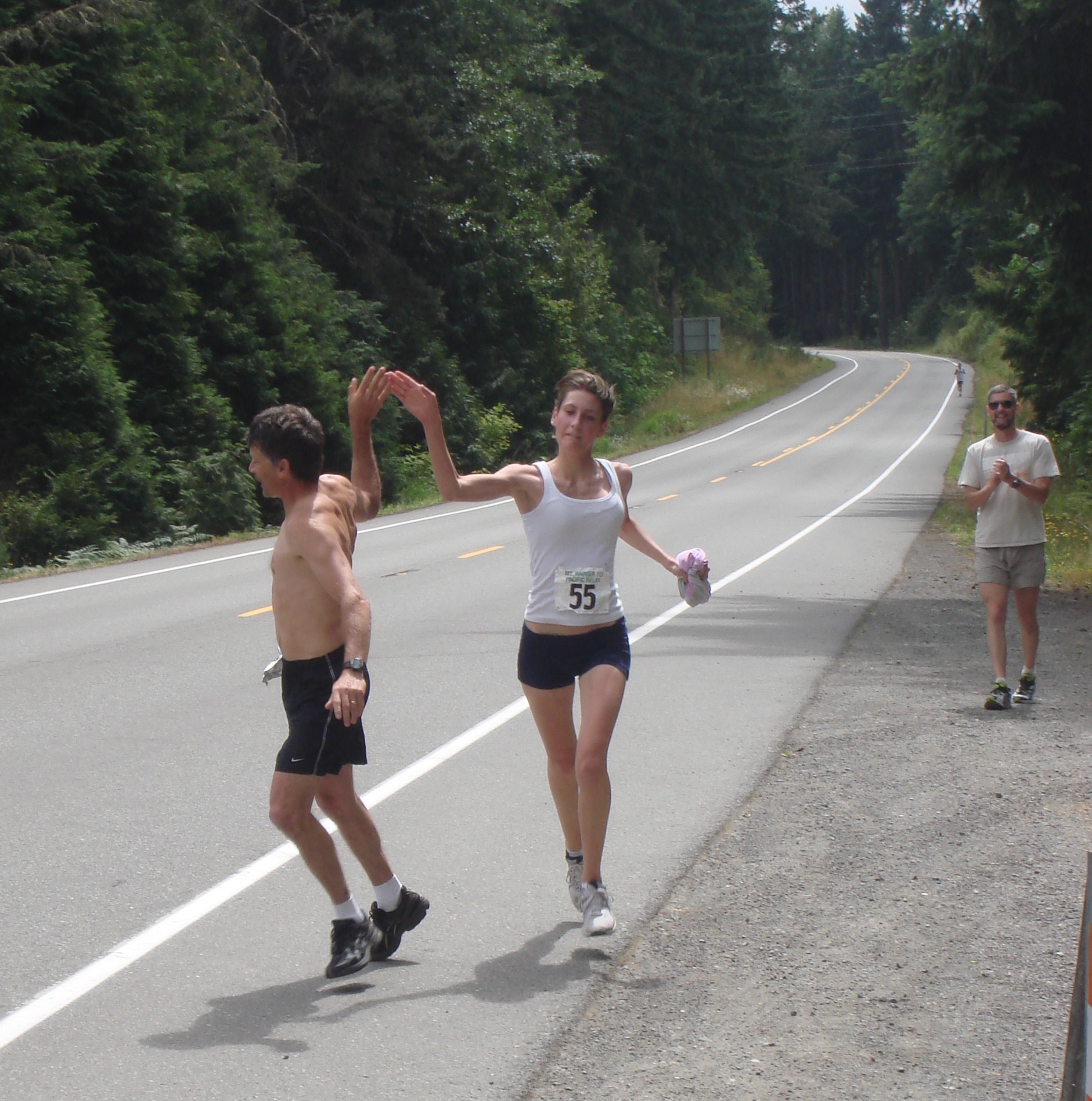
Running the Rainier to Pacific Relay in 2008 was a bit of good fortune. It started with a phone call from my daughter asking if it was okay that she run the relay. Since she was 17, she needed permission and my reputation around the house is Mr. Softee - the kids know it as does the dog.

DSC02062"Sure," I said, "but if you don't really want to, tell them I'll run."

"I told them you would," she said. "They need two runners."

So we ran the Rainier to Pacific relay together. It was the first of four relays that I ran with my daughters - the youngest daughter ran Spokane to Sandpoint with me last year. The first couple of years my middle daughter was in the same van as me. The last year we ran together, she needed space and ran in the other van, hanging with folks closer to her age.

No worries, thinks the dad. I was tickled that we got to share these relays. I ran with them when they were little waifs and cheered at their cross country meets. I was always their biggest fan...

Funny thing - when you run with your babies, they keep growing. You run with them as young kids, then as young adults and the next thing you know, you're cheering for them from a distance. Now, I'm looking at joining Lyn in the stroller division...and it's just...wow...


Take What the Trail Will Give You

When I first started teaching my girls to run on trails, I taught them to take what the trail will give. I've watched so many runners, facing a rocky, technical hill, decide that they will impose their will on the hill. Good luck with that. The hill doesn't care. Nary a bit.

Which brings me to my run yesterday. The hill - in this case, the climb on the Headwaters Trail on Moscow Mountain - was kicking my butt. Yes, I'm out of shape. Yes, it was hot and it was humid. Those were the least of my issues.

I stood at a trail crossing a couple of miles up the hill and contemplated turning around, not finishing the loop. It wasn't a physical issue - I wasn't far from the top as it was. Thanks to the folks at MAMBA!It was mental - I was overloaded, overheated and under-motivated. I was feeling a bit whiny if you really wanted to know.

So I did what I often do. I had an honest discussion with myself...

You can turn back now, Paul. It's all downhill. Feel fast as you cover ground back to the car and it's still a great addition to the week's running. It's just not what you said you were going to do.

And all you have to do is explain to the family how the hill was kicking your butt and you chickened out from the rest of the trail and ran for home.

Or you can keep going, finish the loop. Take what the trail will give, give what you've got ... and be happy with what is.

Your choice. What are you going to do?

So I kept going. For those that don't know me, I have a habit of talking to myself so the above conversation isn't either new or unusual. More importantly, I listen to myself and what I heard was disappointment. Not that the hill was clobbering me - but that I was giving up on me. I still had enough juice to get over the ridge.

About ten minutes later, the trail rewarded me. I know, I said the trail doesn't care but sometimes I just feel like things happen for a reason even if they obviously don't. But I got to see that big bull moose with the massive rack because I hung in to the end.

If I had quit, I would have missed him and the loss would be entirely mine. For those keeping track at home by the way, that's moose, elk, two types of deer, bear, bear cub and a fox seen this summer. Not bad and no cougar sighting except on the WSU campus.

Once I crested the ridge and started down, I was right - I would feel fast. I was whipping through the woods and the foot work started to come back. Little hesitation steps to rebalance past a tree root, quick stepping a downhill. The signs that I'm gradually relearning how to run, aware of the roots and rocks and ruts, the whole body making the adjustments to handle each little change, moving on a more instinctive level again.

The trail may not care but I do so I will take what the trail will give - and I'll honor it by giving what I have.

It's a fair enough trade and I got to see a moose. That's a pretty good run.


The First Rule of Story Telling

The first rule of story telling is to have a story worth telling. I'm currently working my way through Dwight Swain's terrific Techniques of the Selling Writer and enjoying it enormously. Unlike most books on technique, Swain starts with the idea that you must tell a story - something that seems to get lost in some other books that I've read recently which seem to focus on the mechanics as though the engine makes the voyage.

Anyway, I was perusing book blurbs on Amazon. It was a moment of weakness - on a good day, I have an ego the size of Texas. Average days, probably the size of mid-western state like Ohio. Today, I'm cowering under the bed.

What I was looking for where books similar to mine and discovering, no surprise, that there are darned few. Blowing up Manhattan or blowing up strange planets or bodice rippers are recognized genres with their own rules and expectations.

Running books fall into the how-to category or the terminally bad with a few exceptions such as the incomparable John L. Parker's Once a Runner and Again to Carthage - both fine, fine books with great insight into both running and people. Most writers that use running as a part of their novel seem to have avoided the first rule of story telling. Or, maybe I just don't get it.

And that has me wondering...

What the heck is a story worth telling?

Sharing

If you look at the menu bar above, you'll see a link for 'Sharing'. In my posts on my posts about the short story, A Walk with Rose, I mentioned that I would be donating 25 percent of the proceeds to the local Humane Society - this tells you how I plan to do that.

If you haven't read Act I of A Walk with Rose and would like to, just click here and it will take you to the page.

I expect to have the story finished in the first week of August and published by the end of August.

Running During the Dog Days with Your Dog?

Running during the dog days with your dog can be done if you apply a smidge of common sense and understand two things.

First, you are biologically engineered to be an efficient running machine in heat. Your a pro at sweating, you provide a small profile to the sun and you're not covered in fur.

Second, none of these apply to your pooch. Given an option, dogs will elect to siesta during the worst of the heat and, if they do venture into the heat, don't have the same mechanisms to reduce their heat load that you do.

For starters, your dog does not sweat. Most animals don't. They eliminate heat by panting which is why even a fit dog will huff and puff in the Free-Download-Dogs-in-Summer-Windows-7-theme-Dogs-Water-Playbackyard following you as you garden. Short-nosed breeds (think pug or bulldog) have a harder time reducing heat.

Dogs (and most animals) also present a very large portion of their body to the sun. This leads to a bigger surface to absorb heat  - especially in direct sun. The darker the fur, the more heat they'll pick up.

Speaking of fun, did you consider throwing on that heavy jacket before a run in a triple digit heat wave? Didn't think so (unless you're training for Badwater)! Your dog has no choice...

So, here's a few tips for you and your dog.

1. Run during the early morning and late evening hours. It's cooler and the sun is far less direct which will make both of you more comfortable.

2. Plan on slowing down. The faster you try to run, the more heat you generate and the harder it is to bleed it off. That doesn't just apply to the dog - you're body is sending a lot of extra blood to the skin to try to cool it. Give your body - and your dog - a fighting chance. Walking breaks are fine for both of you.

3. Take lots of water for both of you. Put ice in it before you leave.

4. Run in shade whenever possible. This is a great time to get off of the hot pavement and get onto trails.

5. Remember that the dog doesn't have fancy training shoes - hot pavement can literally burn their paws.

6. Keep it short - longer runs increase the risk to your dog as the heat builds up.

7. Going near some clean water like a lake or a river? Think about letting them splash around. Splash with them - it was fun when you were three and it's still fun now.

Enjoy the summer, you and your dog - just be safe.

Run gently, friends.

Swimming in the Snake River at Asotin

Asotin is separated from the state of Idaho by the Snake River and, with summer weather baking the valley, it has been a popular destination for boaters, jet skiers and rafters. I don't own any of the above so I opted to swim. There are little inlets up and down the riverbank, some set with safety markers to keep the boats out. Paddling about in the safety of the cove isn't my style though. Someday my style  is likely to get me killed.

I made my first attempt to swim down the river, starting two miles upstream from Asotin. I will admit that I am more than a touch rusty on my long distance swimming since it has been nearly a decade since I used to swim in the La Jolla Cove in San Diego, which has a protected marine preserve.

Long distance swimming at the Cove was always play time - a good workout while admiring the fish, kelp, sharks - whatever came along.

The river is a totally different environment from ocean swimming - far more challenging and, I think, much more dangerous.

The water temperature was a comfortable 72 degrees when I slipped into the Snake River at a little sandy beach but was much murkier than I expected - recent rainfall had added a lot of silt.

The plan was simple - take off from the beach, check in with my wife at the first mile if I made it that far and out of the water at Chief Timothy Park in Asotin if I continued. That plan, as they say, was good until contact with the enemy - the Snake River.

First, I chose to enter the water above the lake. What we call a river is actually a dammed lake separating Idaho and Washington, Lewiston and Clarkston/Asotin. As you move further from town, you get closer to the river in a more primitive state.

It's faster and sneakier - rock outcroppings hint at the turbulence below the surface but slamming into a boulder - pushed by the weight of the whole river - is a shocking reminder that you only have partial control.

At the time of impact -I bounced off more than one submerged rock before getting braced against one to puzzle out my next plan - I was already getting tired. Muscles that were neglected for too long were running up the white flag.

Sensible people pay attention to such things. I headed for the channel and the choppy current, mindful of the boaters ripping past, prows in the air as they headed up river at speed.

I almost preferred the boulders. Getting sucked into the flow of the river as it heads for Portland. Escaping it required a lot more work with already tired arms and lungs that were severely over-taxed.

In salt water, especially with a wetsuit (I was wearing it for buoyancy - my mother was right when she said I have lead in my ass), you can rest, slow your stroke count, take a breather.

Try it in the river and you'll drown.

So no breathers - I drew an imaginary diagonal to a beach and started to swim to the upstream side of it, expecting that the river would push me toward it. Darn near pushed me past it but I did manage to get my feet down and, gulping some much needed air, had to decide whether I was going to re-enter the water or finish up on land.

I chickened out and the folks in the fancy houses overlooking the river had the opportunity to laugh at the skinny guy trail-running in a wetsuit through the wildlife refuge south of town.

My feet? No problem. I had picked up a pair of boat shoes to swim in just in case I needed to exit the river on rocky surfaces. They handled the surfaces - broken rock, sand, brush - without a problem.

Challenging myself (and Mother Nature) means planning. I knew that I was getting in over my head - literally - and built my contingency plans for that. Taking risks doesn't mean being stupid - though that is sometimes a point of discussion in my household - it means pre-planning what you can, adapting as best you can and accepting your control is imperfect because life and nature just don't care.

You do get to chose risks. Sitting on the couch eating potato chips carries its own risks - I'll take a trail or river, bear or rapids, any day.

Run gently, friends.