First Donation From Royalties

I just cut the first check for the Lewis-Clark Animal Shelter for their share of the royalties of A Walk with Rose. It wasn't much but it's a start and fun to do. For those that don't know, I pledged 25 percent of the profits of the book to the Shelter. Since the royalties weren't huge this time, I gave them all of it.

Hope to do more of this in the future. Pretty much any of the dog stories that I write will operate this way.

And to the folks that got free copies for helping with the cover design and then donated to the shelter when they picked up their copy? Yeah, you ladies rock! Many, many thanks!

How would I write that?

Finishing an online class (Character Voice and Setting) with Dean Wesley Smith and he offered a piece of advice in the final video. When you are out in public, pay attention, watch people, what they do, what they say, how they say it - and then, think to yourself, "How would I write that?"

Dean runs the class over a six week period and imparts a ton of really useful craft advice while simultaneously shifting your perspectives on both writing and people. It a tough class, and yes, there's homework. I only recommend taking it if you want to become a better writer and want someone to give you specific advice on what your screwing up and why. On a good day though, you might get a note that says you just nailed the assignment.

I also recommend note taking. Lots of information there and I've watched some of the videos three and four times.

If you are interested in Dean's classes, head over to his website. The man is incredibly prolific so there's always new content there.

In the meantime, I'm going to get some work done, go for a splashy run in the rain, and then, to the store. Shopping for dinner will take a little longer. I expect to get distracted as I wonder to myself, How would I write that?

And then figure out why.

And how I could tweak or twist it.

Strawberries, a short story

A rough draft of a short story I started this week. . .

Strawberries, a short story

Leroy timed it so he bumped into Gladys as the wedding guests squeezed out the doors and into the June sunshine.

“Sorry ‘bout that,” he said. His voice reflected too many years on a tractor sucking in the dust and fertilizer past vocal cords and into lungs. A smoker’s rasp for a man who never lit a cigarette.

Small beads of sweat lined his pate as he tried to subtlety watch her to see if the nudge at the hip had angered her. She hadn’t even looked at him as she rebalanced. The little stumble put them both away from the flow of traffic. He wiped his head with a handkerchief.  

Gladys was ten years younger than Leroy. The women in their small town came from good German stock but unlike the majority of them, she had maintained a trim figure as she had aged. She had finally let her hair go a silver-gray, Leroy noted with approval. It was a darn shame her last dye job had turned pink. He liked it better all natural like this, he thought. It played good with her pale blue eyes.

“Wedding was kinda in’eresting, pastor getting’ all sideways and what.”

Gladys arched an eyebrow.

“I wouldn’t call it interesting,” said Gladys. “For a moment there, I worried that Pastor Austin was going to ruin the wedding for that young girl,” she said. “That would have been a real shame. A bride only gets one wedding day.”

Gladys put on her wraparound sunglasses, the kind with the little side shields that fit over her regular lenses and hitched her oversized purse onto her shoulder. She was making to join the flow of people, he thought, and head on over to the reception at the grange.

“Maybe Pastor was celebratin’ early,” said Leroy. He winced, the joke falling flat even to his ears but it stopped Gladys from walking away.

“That’s a poor thing to say about the pastor,” she said, turning to face him.

Leroy put his hands up reflexively.

“Just a bad joke,” he said. “No harm meant. Just real su’prised ‘cuz he’s usually so smooth and easy, preachin’ I mean.”

He hoped the apology would mollify her but she held a stern gaze on him. Too late, he remembered that Gladys had been the chairwoman of the search committee that brought the new pastor to town from back east.

You damn ol’ fool, he thought to himself with an almost imperceptible shake of his head. Fine churchgoin’ lady and you poke fun at her preacher.

“The grange is set up real nice,” he said into the chill space between them.

He rambled, trying to change the subject. “I went on down and help’d get it set up. Mary Lou did up all the flowers, real pretty, for the tables and I hear that Bob Cousins got the meat on the cooker since ten this mornin’.” He paused. “I got together a bunch of strawberries outa the garden, ‘bout twenty pounds worth for the kids.”

He offered the last bit studying her face. The last two weeks, on Tuesday and Thursday, when he came into town, he’d brought baskets of strawberries from his patch in the back and left them on Gladys porch. He didn’t leave any notes, just the juicy berries, red and fresh and sweet as sunshine.

Her head gave a little jerk when he mentioned the strawberries.

“I think the little Olsen girls have been putting strawberries on my swing,” said Gladys.

He felt warm inside and pleased but he didn’t tell her that he was the one dropping them by her place. She was adjusting her purse again, getting ready to leave. He’d walk with her. Everythin’ in its time, he thought and smiled.

Gladys continued.

“I’ll have to have a talk with them, I suppose, and get them to stop.”

“Stop?” Leroy tried to hide his confusion. “Whata ya mean, stop? Why?”

“Poor girls are trying to be so nice and neighborly, but I’m afraid I’m deathly allergic to strawberries. I just hate to disappoint them.”

Gladys turned away and Leroy let her walk away, alone, as he stood there, feeling crushed.


I need to go for a run . . .

No real comment. Just, the weather stinks and I'm tired of the gym and the ideas don't come until I get out on the trails. Also ready to be done with the latest class. Learned a lot but I need to get back to my stories, my characters. The class I've been taking is a craft class on writing better characters. The biggest lesson for me hasn't come directly from the class. It came because of it.

I write the characters I do - Callie in Finishing Kick and now Becca in Trail of Second Chances, Gracie when I get to her, Pete Archer who's waiting patiently at the start of The Lonesome Mile - because I care about them and their stories. When Callie is learning to be the leader that her team needs her to be, I'm cheering when for her. When Becca is struggling with her dad as her coach, I sympathize - and think of my poor girls, who handled it so well.

Some writers, James Patterson for example, outline the story and hand it off to someone else to write. He has (reportedly) a whole stable of people who will work with him on this. Other writers are very, very good at developing the stories within a framework, like the old writers of the Nick Carter series or Star Trek.

But I'm not that type of writer, at least for now, and I'm pretty sure I don't want to change that. The folks in my books are nearly real to me and, if I ever get enough skill, I hope that they become nearly real for my readers.

Which I think numbers about six people right now, but it's a very loyal six. That makes it worthwhile.

Another Homework Assignment

Not my usual type-or tone- of writing but part of the process of learning to be a better storyteller involves stretching a bit. This piece is an example of me having to do that. Let me know what you think. . . ___________


Wyatt felt his features twist as his feet planted themselves in the crushed gravel. It was visceral, the subconscious dredging up buried memories. He stared at the towering stone walls of the church for the first time in four decades, noting how little it had changed. The dark gray stone seemed immutably mortared into position, unyielding even under the impact of a small body.

His, as he remembered the feeling of the jagged points of the basalt cutting his back as the older boys taunted him. The quarried stone looked smoother from a safe distance. The base of the walls was massive, three feet thick, the blocks of stone the size of a small steamer trunk, shelves of them that would never budge once placed.

The gravel path to the church split dark shadows cast by the building from the vegetable garden, a profusion of irregularity compared to the strict organization of the building.

Another memory, brought back now by the smell of the manure from the garden: the mortifying smell of the urine running down his leg.

As he relived the embarrassment, the windows stared at him, knowing him. They were tall and rounded at the top, with smaller circular windows set above them, each with wooden muntins separating the panes of glass. They watched without blinking, all the people in their crosshairs. Above them rose the cross, set on the top of the bell tower. The tower, rising from a bald, barreled roof, was capped in wood, freshly painted and blood red. The cross was hard to look at, outlined in black against the intense blue of the June sky and unapologetic after all these years.

The large brass bell in the tower had been carried in from the old church after the congregation had fractured. It sat there at the end of a rope. Was it the same rope?  

Would they have left it until rot claimed it?

It would toll at the end of the wedding today. That was the way it was always done, he remembered. It was an old world custom brought to the prairies of Idaho by founders as hard and resolute as the basalt bedrock. The bride would enter through the front doors on a promenade to the altar. Together, she and the groom would exit to the peals meant to signal the joyousness of union.

The vibrations of sound could be felt, changing a heartbeat with the impact. People would hold their chests at the sound and cheer the couple.

Only he would hear the ominous warnings from the past, bouncing on the end of a rope.

With bile rising in his throat, he stepped forward to the door, oblivious to the other guests.

When he got there, he knew he would pull on the iron handles and expose himself to the past—and the future.

He would open it and step into the belly of the beast, while the round eyes under a Christian cross marked him for what he was.


What was the first novel you ever read?

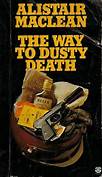
The Way to Dusty DeathI just got in a couple of books (okay, 14 books but most of them were non-fiction) that I ordered, one from the UK. That one was "The Way to Dusty Death." Written in the 1970's by Alistair MacLean, this was the first novel that I ever read. I was ten at the time and was considered to be a very poor reader. More on that later. . . I read the book in a single sitting. MacLean didn't waste much time or wordage with anything outside the storyline. Compared to his contemporaries, there is no sex and no vulgar language, just non-stop action in faraway places. In short, a safe book for a 10 year-old boy with an active imagination.

The copy that I got, used, from The Orchard Bookstore in London, was in good condition with that mustiness that comes from an older book. A second printing, it had a different cover than the one that I read all those years ago in Australia. Inside the covers, though, it was the same story.

Because it was a UK edition, the language and punctuation were both customized to that country. The language I noted immediately. Using tyres for tires bothers me not in the least and there were a dozen more examples of the differences between English and whatever it is that the blokes in the UK call what we speak.

It took me 30 pages to realize that the punctuation was also different than used in the States. It was little things - using a colon to transition to dialogue, as in:

Dunnet said: 'Well, I suppose we've got to face it sometime.' MacAlpine said: 'I suppose.' Both men rose, nodded to the barman, and left.

And the quotes. In the States, we use the " to indicate speech. If you didn't see it, look at the example above. A single ' for the dialogue.

So I noted it in page 30 (or so) and promptly forgot about it, moving back into the story which, pleasingly, has held up well.

I've reread some of my childhood favorites and not all of them has. E.E. "Doc" Smith's Skylarks of Space series is one that has not translated well into the modern world. Written at the beginning of aviation, the science has become outdated and the characterizations almost Victorian. Some of the presumptions of society, the rich playboy who owns his own biplane and lands where ever he likes is a remnant of a bygone era. I haven't read any of the old Doc Savage novels but I wonder if they don't suffer similarly.

The Way to Dusty Death is set in Europe (still around), features Grand Prix racing (still around), drugs (still around), and a pretty girl (thank goodness they're still around!). Some of the attitudes are old-fashioned but still recognizable unlike Smith's series.

And I find it sad that no one writes books like this anymore, with generally strong story-telling. MacLean didn't spend pages discussing the role of the rear outside stabilizer in a race car and the effects of damage to it a la Clancy who quite literally did spend pages on a new propulsion system in The Hunt for Red October. Not a complaint against Clancy, it's just a different style, one that introduced a whole new sub-genre, the techno-thriller. Nope, MacLean sabotaged the stabilizer, caused the crash, and off we went. Cause, effect. No engineering degree required.

He also didn't go into great detail about a punch. Lee Child has his punches last for paragraphs, from calculation of time to initiate action, consequences, launching the strike, the muscle movement throughout the arm, the moment of impact, the effect of impact, the aftermath of impact . . .

MacLean's version: Johnny Harlow gets hit by a sap.

And again, we move on with the action.

And, for a young boy, one that's not a great reader, action was what I wanted along with heroes. I mentioned I was considered a poor reader at age 10. I was, though I knew the mechanics of reading. Then we moved to Alice Springs, Australia. Interesting point about the Alice at that point in time. There was no TV. None.

Plenty of sunshine and more open desert than a pre-teen had time to explore. It's amazing that none of the kids I hung with ever got bit by a spider or a snake, considering we'd go hunting for them. Or that none of us fell off a cliff rockclimbing -  though Phil Decosta tried once.

But no TV. As a family we played a lot of cards and learned to shoot darts. But those require other people.

Reading doesn't so, against my mother's wishes, I started reading comic books, began devouring them. This was before comics became graphic books. Back then, they were just comics, Sgt. Rock and the Archies and the Green Lantern.

We were in Australia six months when I saw a book, black cover with a silenced gun, that caught my eye. No one told me it was an adult book and beyond my reading level. My mom saw me reading it, nodded, and left me to it. Today, a teacher would take it away and give the kid some pap that he'll toss on the desk and ignore. But that book was my first novel. . .

That book was a turning point. In a very short period of time, I went from not reading to reading 1-2 pulps a day. I wiped out the entire school library, primary and secondary, of the thrillers and sci-fi in a couple of years. Also knocked out the sports stories. Dabbled with Leon Uris and Michener.  Decided that Michener must have been paid by the word and moved on.

I visited the Moons of Barsoom, the jungles with Doc Savage, and wanted to be the Grey Lensman or James Bond. I fought the mafia with Mack Bolan, became the Destroyer with Remo Williams, and visited Rama with Arthur C. Clarke.

I loved books, or more accurately, I loved stories and read voraciously to soak them up.

All because I picked up a book and nobody took it away.
Homework can be fun

What follows is part of a homework assignment from a writing seminar I'm taking. This little piece was fun to write and my girls enjoyed it, too. So . . .I hope you enjoy it as well.

My bangs were way too long but I liked it that way. It hid my eyes.

I could feel my dad looking at me but it was mom who talked non-stop about what a great opportunity it was for Dad and how it would be sooo nice to move to a smaller town where we would have things to do as a family and I could find some friends and once we get there we’ll figure out what I need for graduation since it’s my senior year.

The words drift over me like little bubbles of I don’t care and pop.

I like San Diego. The weather’s perfect and there are plenty of places to go when everybody starts pushing, pushing, pushing, come on, let’s go to the movies or we should try out for, always followed by whatever the cool kids were doing.

I wasn’t a cool kid.

I’m just me, the odd kid that everyone shies away from. Except the other odd kids. We hang together but they wanted to be like the others, blend in.

“You need to eat something.”

My mom is worried I’m anorexic or something. I encourage the worry. I give the edge of the plate a push, move it maybe a half-inch away from me.

“Well, if you’re not going to eat, you can at least sit at the table properly!”

She was using that I can make you voice. I give her the No, you can’t shrug. It’s going to piss her off. Like sitting cross-legged in the chair, all scrunched up with my hair almost resting on the top of the table pisses her off.

It’s my talent.

My dad finally talks.

“I think you’re going to like Idaho.”

No, I’m not. It’s Idaho.  We live in San Diego. No contest.

“We’ll see,” he says like I answered him. He’s a little freaky like that.

I hear him slide back his chair and I tilt my head up just enough that I can see his hands. He picks up my plate with his.

“I’m going to go read news on the computer,” he says. “I’ll wrap her food and put it in the fridge.”

I know he’s talking to her but helllloooo, I’m right here. Don’t talk about me like I’m not here. But I don’t look up, don’t say anything. I’m in my perfect little bubble and I don’t let him into it. Or her.

Or anybody.

He stops on the way to the computer.

“We’re moving to Idaho. How you decide to deal with it is up to you.”

He sounds very reasonable, like he’s doing me a favor, letting me choose how to feel about it. He does this a lot. Mom is easier, she just yells. Sometimes I yell back. It’s cathartic.

And Mrs. Rose thinks I don’t pay attention in BritLit. Cathartic. I like that word.

He’s still standing there, watching me.

I don’t tell him but I decide.

Idaho’s gonna suck.


Victoria's Secret

Just a short note on something that struck my funny bone that I got from Victoria's Secret.

I got a flyer - addressed to Paul Duffau, not my sweetie - from Victoria's Secret. I don't know why unless it has something to do with mentioning the chain in Finishing Kick. Or maybe it's because I write books for young ladies (who run) and have to channel my inner girl when I write.

They were offering a "FREE V-Day Lacy Thong" if I bought a bra.

I decided, based on the models, that the bra would not fit and really, it's not my style. At all.  My sweetie said she never, ever wanted to see me in a thong, either.

Seems reasonable. But it did give me a pretty good chuckle.

Races around Asotin

Time to look at some local races around Asotin. The holidays are over and, if my scale is correct, the damage was minimal - except to the habit of running. Since I have a marathon that I need to be ready for (running, not racing), I need to get it going. The nice thing about marathon training is missing a day won't break you. Trying to do too much, too fast, might. Patience, perseverance, and a good sense of humor will get you to the start line. In the meantime, we have a bunch of local races on the calendar. I'll only probably do two, one as a training run, the other as a benchmark to see where I'm at.

Here are all the races I could find in the area for the late winter/early spring.

Feb. 8 - Sweetheart Run, Lewiston ID - 4 mile run or 2 mile walk, benefits local youth charities.

Feb 15 - Edge of Hell, Lewiston ID - 4 or 8 mile trail run in Hells Gate State Park. Beautiful scenery and one of my favorite areas to run in the Lewis-Clark Valley. If you look across the river, you can see my house.-and most of Asotin.

Feb. 22 - Celebrate Life, Lewiston ID - 7K run, 3K walk, benefits kids with cancer.

Mar. 1 - Snake River Half-marathon, Pullman, WA- 13.1 miles of running beside the Snake River, sponsored by the Palouse Road Runners. No traffic and a course elevation chart that looks like this: ________________. If you run it, I'll be at the 4 miles aid station cheering you on. The rest of the Asotin cross country team will be there along with Coach Tim Gundy, manning the 4 and 6 mile stations.

Mar. 15 - St. Patrick's Day 5/10K, Clarkston WA - Your choice of distance on a fast course. You have to wait for the holiday itself for the green beer.

Mar 21/22 - Snake River Triathlon, Lewiston ID, The swim is Friday, the evening before the ride/run. Check the website for details. The race is put on by Lewis-Clark State College's Cross Country program. Mike Collins, the coach, does a great job of organizing the event and it is chip-timed.

Mar 22 - Hells Canyon Adventure Run and Ultra, Idaho - A self-supported run of either 15 or 28 miles depending on which version you choose. 100 percent on trails in Hells Canyon. This is the one on my list as a training run.

Mar 30 - WSU 100K Relay/Solo, Pullman WA - Got some friends? Grab them, put together a team and have some fun with a relay. If you don't have friends crazy enough to join you, you can always run it as an Ultra. I heard a rumor that since this is the 25 Anniversary, the Palouse Road Runners are planning  25 percent weather. We'll see how that goes.

Apr. 5 -  Mike Jensen Memorial 5K, Lewiston ID -  Another charity run, this time for grieving children.

Apr. 18 - Twilight 5K, Lewiston ID - Another of Coach Collins events, it's a fast, flat course on the levee. This will be my "where-am-I-at?" race as I get ready for the marathon in Colorado.

Apr. 26 - Seaport River Run, Clarkston WA - I'd put up a link but the City of Lewiston hasn't posted it yet that I can find.

Apr. 26 - St. John Hog Jog, St John WA - I haven't done this one and maybe it's time I headed up. 2 and 5 mile options in one of my favorite little towns. Also the chief competitors for Asotin Cross Country girls and really nice kids.

So that gets us into later spring. Pick a couple and have some fun.


Nice Mention at the Book Designer

Pageflex Persona [document: PRS0000035_00034] The cover for Finishing Kick got a nice mention at the Book Designer blog run by guru Joel Friedlander. A nice win for the designer, Kit Foster of the UK.

JF: Very effective, with lovely typography.

If you're interested in books, how they get put together, and what compels a reader to pick up a particular book, Joel has hundreds of articles to satisfy that itch.

NaNoWriMo

Below is a letter that I wrote about National Novel Writing Month (NaNoWriMo) which is every November, during the last such occasion. Lost in the blitz of 50,000 words in one month (very doable!) was a point that bothered the hell out of me. When in doubt, seek out a wise woman . . . Sorry to trouble you with an email rather than post to the comments of your NaNoWriMo post but didn’t think that the comments I had fit the discussion. Fast background – I’m a new writer, in my 50’s, male, far less than a million words of crap written. I don’t have time for a million words of crap.

I put words to paper before I learned any craft-and that I’m learning from books, James Scott Bell and Dwight Swain and James Gardiner. Just reread/listened to Steven King’s On Writing.  Despite the presence of two colleges and two universities, there do not appear to be craft classes in my region. The writers that I do meet (often during the day job) are engage in a fanatical pursuit of literary recognition.

I’m not.

I started writing fiction because I couldn’t go for a run without a scene building in my head that would bring tears to my eyes and my run to a halt. So I attempted to exorcise the beast by writing a prologue-and it made people cry. And the beast fed on it, so last year about this time, I sat down and started pouring it onto paper and, in June, had a novel. I fixed my more egregious errors and handed it to family and a pair of 13 year-old girls that I help coach during cross country season.

Family cheered, cried, and declared it good. In the family of one beta reader, it caused a fight. I’ve coached all four girls, and the youngest was the one that had the book. The others swiped it, read ahead, talked about plot and characters and funny bits; tears ensued and rules were set up so that Carmen could finish first.

All of which is great validation but scares the crap out of me.

I know my craft isn’t solid. I stand in amazement of truly gifted writers and respect both the genius and the dedication it takes. I’ve taken several of Dean’s classes, primarily those orientated towards the business side to be able to bring a product to market that exceeds standards. My goal, stated to my cover designer, is to put out a product that is as good, or better, than what the Big 5 consider acceptable.

One of my jokes is that I’m an ultrarunner because my primary skill is being too dumb to quit. It works for writing as well. The day job helps, too. I get called an idiot often enough that it no longer raises a hackle. In both, I know how to improve.

In writing, I’m trapped between worlds. The number of good classes out there seems to be in inverse proportion to the ever-expanding number of offerings. The higher status workshops will never take me – not only do I lack the requisite MFA, but I lack even the university pedigree. The workshops that promise skills often too often seem intent on teaching the skill of wisely selecting courses that will cost the least in lost lucre and time. They are, however, profitable to run as are ventures such as Author Solutions.

You and Dean have some courses that I’ll be taking as does David Farland. After that, it seems a bit thin. I generally rule out anything promoted or heavily influenced by agents.

In the meantime, I am running out of books that seem worthwhile. Some seem downright awful. Most by literary writers are neurotic as hell which gets a little tedious. The blogs are worse.

After that, where does someone stuck (willingly) in the middle of nowhere go for training. I don’t need a pat on the back – I have long arms, I can do that myself. I need someone honest enough to kick me in the teeth and point out what I must do better to be a successful writer.

I don’t count success as a best-seller or in money though I’ll take both if they come along. My books are landing in the valleys situated between the genres. Either they’ll become highly successful niche books or they’ll disappear soundlessly.

My ego is such that I expect the former. I know you caution – as does Dean – against expectations too high. But I’m defining success my way, and, if I land in that perfect space where people yearn for a literature about them, I’ll sell a book or two.

I want my readers to feel what I feel. I’m not asking for riches or recognition, I just want the girls (most will be girls, which is ironic to this middle-aged man) to lose themselves in a world that was created for them, that’s authentic to them, and be inspired.

And the early readers are saying that they are, even if they don’t know it. One of them, at the District meet referenced my main character, saying she was “going to pull a Callie.” More high praise. . . and I cringe

Because my craft isn’t good enough, not yet and these girls deserve better than I can give them now.

So where do you go to learn how to create a memory? Not plot. Not setting, not any of the parts of the story. How do you learn to create something that will give them a memory that they can use now and twenty years from now?

How do you touch them and show them their own beauty?


Running Quote of the Week

I'll see how many of these I can track down. Here is the redoubtable Dr. George Sheehan. I highly recommend his books, especially Dr. Sheehan on Running. It's not a book on how to run faster or longer or even better. It's a book on why we run, what moves and touches us to be runners.

"It's very hard in the beginning to understand that the whole idea is not to beat the other runners. Eventually you learn that the competition is against the little voice inside you that wants you to quit." - George Sheehan

If you are a sales person, I would suggest listening to Blair Singer (or reading the book but I like the CD I have) and his Little Voice Mastery Systems Audio CD.

Is it a New Year?

Okay, it's time to layout a few goals for the New Year. I came into 2013 with three writing goals- first, to become a writer, then become a professional writer, and after that, a paid professional writer. I managed all three though I set a very low bar for the last item. I made enough that I could afford more than a single cup of coffee at Starbucks and counted that as a win. Along the way, I racked up nearly 200,000 words of writing between two books, a couple of short stories, and the blogging. The finished novel, Finishing Kick, is up for sale at all the major online places in print and electronic formats.

I also had a goal of shrinking the business by twenty percent. Missed that one badly and basically didn't downsize it at all.

I had no running goals. I couldn't run at the beginning of the year and this was possibly my most painful year since I was about seven. The meds the doc put me on for the gout triggered a non-stop 6 month attack with a brief respite when she pulled me off the pills for a month, worried about liver and kidney damage.

Turns out that neither was a problem and, when she put me back on the pills, the worst of the attacks had passed. By June, I could run a mile and a half and, by year end, ten. None fast but that's okay.

Now for this year's goals.

Writing, 200,000 new words, which is about 4,000 per week. That will give me at least two more novels or a passel of short stories. Blogging and Facebook don't count. Publish two more pieces of work and list them for sale. Start (hopefully finish) a novel in a new genre. Get one review from a notable in the running field for one of the books.  - good or bad.

Work. Still trying to downsize.

Running. A trail marathon with a friend. A trail run along the Snake River in Hells Canyon that I've wanted to do and not managed to schedule. And maybe, if everything goes well, a small ultra run. Mostly because I miss it. The Seven Devils call . . .


Reading a Novel is Good for your Brain

I'm suffering early from the post-holiday blahs - I should be writing but meh, not in the mood so I surfed the internet and came across an article in the Independent that cites a study that says reading a novel boosts brain function. The primary area of the brain affected is the left temporal cortex which, according to the article, controls language (makes sense) and is the primary area for processing motor sensory data. Scientists speculate that this area of the brain 'tricks' us into thinking that it's doing something it's not - the example they use is that reading about running can trigger the same neurological activity that actually running does.

The improved function lasted at least five days after completing the novel, too.

Now, the part they didn't mention is whether this is good or not. I'm presuming that it is - we learn through stories and placing ourselves squarely in the role of the protagonist (unless you want to be a serial killer or something in which case be Dexter or the antagonist) should be an advantage.

It might also give some hints on how to educate kids. I expect this to get buried by the mis-education establishment.

Anyway, I did manage to write about 500 words, not counting this blog post, so it's not a totally wasted day. I'm going to settle in with a good novel and improve my brain.

The glass of Shiraz? That's for my heart . . .