Anybody need a virtual training buddy?

I do.

I'd actually like to have regular training buddies but my schedule is unpredictable as heck and I have a lot of activities that need to be squeezed into tight timeframes. I know that there's a group that gets together every Saturday morning for a run. I work most Saturdays.

Tuesday night, the Palouse Road Runners have a speed workout at the University of Idaho track. It's an hour drive to get there or sticking around a couple of hours after I'm done working, depending on which town I'm in at the end of the day. Plus, the group has gotten quick and shed it's reputation of being an all-comers type of event. Workouts are now getting built for people averaging 50-60 miles per week.

The Striders have a beer-run group on Wednesdays. Sadly, beer is bad for me and they only go 3-ish miles. Slow as I am, it takes me that long to warm up.

So, I'm thinking a virtual buddy. There are sites out there that cater to people like me. Think I'll check them out and report back.

Run gently, folks.

Drop Off Runs

My last several long runs have been "Drop-off runs despite the fact that I have an angel in residence who will crew me if I ask. One of her ideas of quality time is to chase me out the door before dawn, drive ahead two miles, and wait for me to trudge into view before handing me a water bottle and a smile that says, "You're doing great."

So why, if I have crew, would I choose not to utilize it?

The easy answer is that I'm mental. The purpose of the long run is to create the physiological changes that allow for greater energy utilization. The body adapts by increasing the capillarization for blood flow allowing more nutrients - food, oxygen - to reach the working muscles. It also increases the number of mitochondria in slow twitch muscle fibers to aid in generating energy from the food and oxygen.

That happens if I have crew or not.

What changes is the option, every two miles to jump into a warm car, and think "That's enough for today."

Once I get dropped off, I'm on my own. I carry a little cash for emergencies but no phone. Also, I always get myself dropped off a little past my last long run distance. I've done enough of them that I know that my last long run is an excellent predictor of my endurance training distance. Generally, I plan on two miles farther each time until I reach my desired distance. The two mile mark is important. That's when my brain starts to tell the body to shut down, we're gone too far.

Matt Fitzgerald brings this up in his book Brain Training for Runners. (Great book, btw.) The brain, sensing that we've extend past our comfort zone, acts to "protect" us from damage by sharply curtailing the chemical signals that keep us happy while we're running. It part of our subjective feedback loop.

So, my current goal with the long runs isn't building the body. It's building the mind, conditioning the brain and my will to continue past the barriers that appear to be in front of me. My last two runs, I broke down two miles before the end. Both times, I managed to restart after breaking, forcing past the "I'm done" phase. Those first few strides were crap, sloppy and awkward, but they smoothed out.

The brain will learn, more can be done. Next week, I'll add another mile or two and go through the feel really good phase, the "this is work" phase, the "I'm done" phase, to the break-through phase.

As I rebuild my body, I'm rebuilding my brain and my will. Halfway around a 30 mile trail loop in the middle of nowhere, I'll need them to believe.

Easy Advice to Offer?

I think this piece, Admit It: You're Rich, by Megan McArdle is brilliant. Now, that may just be because I agree with her and point it out to people who complain about the rich, usually with an offer to take a check representing their net worth minus $2,000 to the Gambian embassy so they can help out the poor.

So why don't we feel like Scrooge McDuck, rolling around in all of our glorious riches? Why do we feel kinda, y'know, middle class?

Because we don't compare our personal experiences to a Tanzanian subsistence farmer who labors in the hot sun for 12 hours before repairing to his one-room abode for a meal of cornmeal porridge and cabbage. We compare ourselves to other Americans, many of whom, darn them, seem to have much more money than we do.

Envy tends towards ugly. So instead, enjoy the blessings you have, feel free to work hard to earn more, and do not begrudge others what they have.

Unless it's a sub-3 hour marathon PR.

Nah. On second thought, just go run your guts out - you're still miles ahead of the rest.

Talking Myself into a Long Run

Me: 6AM and the bed is warm.
Inner Me: Time to run
Me: It's 23 degrees outside and dark
Inner Me: Time to run
Me: It snowed!
Inner Me: Time to run. Shovel the walkways first as a warm-up.
Me: It's early, I'm creaky, I'll run tonight.
Inner me: Pah! Enough whining. The Wimp Rule is in effect.
Me: I HATE being called a wimp!
Inner Me: Whatcha gonna do about it?

So, 10.5 slow miles later, icicles in my beard, Inner Me is happy. Breakfast time.

Sharing Update

If you've read my books, you already know that I share a portion of the proceeds for both running books with local (defined loosely - we're rural, so local can be a hundred miles away or more) high school cross country programs.

The first check went to Clarkston High School. The kids there are awesome and the folks that run the program help out everyone else in the area.

I wasn't sure how often I would be doing the donations. It seems that a semi-annual basis will work nicely. There was a little push at Christmas, plus I had two different cross country teams buy directly from me (which saves them money.)

I've already decided which team gets the donation, though I'm moving a bit further out and sending the check to the Tri-cities area.

As with the first check, I wish it was bigger.

To those of you who have purchased my books-especially to a certain young lady and her mother who drove into Clarkston from Pomeroy to get copies- thank you for reading my books and, by extension, helping some kids running at the high school level.

The Secret Race by Tyler Hamilton

The subtitle to Tyler Hamilton's book, The Secret Race, is Inside the Hidden World of the Tour de France. It makes for a sexy bit of marketing - look, see the underbelly of the most celebrated bicycle race in the world - but it isn't accurate. It wasn't just the Tour de France, it was in every race for a decade and probably still goes on today.

In Search of Perfection

Runners and writers share similar traits, many of which qualify as self-inflicted abuse. "Write until your fingers bleed" is analogous to "I lost another toenail." Personally, I count those as badges of merit.

One affliction that both have that I wish could be banished is the idea that we can achieve perfection. I'm reading Kris Rusch's The Pursuit of Perfection: And How It Harms Writers (among five or six other books I'm also reading concurrently.) I hit a part that reminded me of this last cross country season and a young lady who wants to be perfect.

She's a talented runner, outstanding student, and a nervous wreck at the start line. A lot of kids are, which I really didn't get until recently. I'm more of a "pre-worrier" in that I get all of the angst out of my system days before a race. Once the number gets pinned on, my focus shifts to the work at hand.

It finally dawned on me, slow that I am, that she was worrying about the results of the race, not the race itself.

This, by the way, is not a 'girl' thing - some of the guys fight through the same issue.

Writers go through the same process, worrying about their books or stories long after the work is done and sent off, or in many cases today, indie published. Kris recounts a tale of a blogger who stated that a writer should use the one-star reviews to help re-edit a published work.

Sounds insane to me, though Kris was kinder. I have received bad reviews - one publicly, a few privately. The public one (you can find it at Goodreads if you're so inclined) I did pay attention to - she mentioned typos in the finished product, among her other complaints. Those I went looking for, because production errors aren't acceptable. In 126 cases of you're and 133 of your, I couldn't find the ones she said were done incorrectly - neither could my editor.

But I didn't contemplate rewriting the entire novel to her satisfaction. Am I disappointed she didn't like it? Yes. I also know, from the feedback from others that loved the book, that the parts she didn't like were the most popular with others.

Runners fall into the same trap. We get so wrapped up in what others do - they had a killer workout, or a PR race - that we forget to take care of our own business. Worse, we forget that we can only control one thing - our effort.

If the weather is lousy, it's lousy. The course is hilly, well, everybody else faces the same hill. The race is loaded with Kenyans who will be finished before you reach the halfway point, c'est la vie. Their race is not my race.

In the young runner's case, I made a deal with her at the start of her last race - go out and run in front of her closet competitor. My young lady had worked hard in the summer, came in fit and ready, but kept following a Pullman girl into the chute. So I told her to run in front, and to count on her courage to fight to the end of the race. I also told her that I believed that she could do it - and, if it turned out I gave her bad race advice, she was welcome to run me over with a car when she got her license. But until the race was over, I wanted her best effort.

I got a smile about the car joke and then the race started. She ran like a dream, focused on the competition at hand instead of the finish, and for the first time all season, finished with a smile.

You can't create a work of art, whether a book or a race, if you worry about the final result more than the effort to get there. The energy and courage to put yourself to the test is the forge for the art, and the love and the passion you bring to it shapes it in the heat of the moment. Greatness happens in those moments.


End of the World Run Recap

Some of these very cool shirts are available for sale - contact me or Tim Gundy for details.

Some of these very cool shirts are available for sale - contact me or Tim Gundy for details.

The Mayans still aren't right - the world hasn't ended. In fact, race weather was in the 50's so all the kids and some of the adults ran in shorts and a tee shirt. Hardly December-like. More like, say, San Diego, minus the crowd, pollution, and the highways that will be backed up until the second of January.

Not a huge turnout - I think maybe the race is too close to Christmas and a lot of folks have left town. Still, the Asotin XC folks appreciate everyone who did come and hope to see the rest of you at a race or run soon.

Run gently, friends, and enjoy the great running weather we've got.

Volunteering at Races

Running, unlike the 'big' sports which pay employees, runs on volunteers at nearly every level. Almost all the workers at local XC meets are volunteers, as are the ones at most marathons. Even the high school coaches work nearly free - certainly under minimum wage given the hours they keep.

One exception is the Snake River Half-Marathon (filling fast, so enter soon!) which has been very generous in paying the Asotin XC teams to man the water stations at the 4- and 6-mile marks.

Generally, I figure that a race averages one volunteer per one hundred runners. Small local races actually have an easier time gathering volunteers as the spouses or parents of younger athletes jump in. I think bigger races come with a presumption that everything is paid for, so volunteers are less necessary. Certainly, the relays I've run have put their collective feet down and part of the entry is to provide two volunteers or cash to hire someone.

In Asotin, we have a core group that shows up to help and we've come to depend on them. But every race could use more help. The gentleman who does all the starting for the local HS track and cross country events has been doing it for nearly three decades.

The same thing happens at the club level. The same core of people tend to manage the group and the events year after year.

They could use a smidge of help, so I have a favor to ask of you. If you're a parent of an athlete, can you volunteer one time next year to help out the program? If you are in a running club, can you help with one race instead of running?

It doesn't take much but your fellow runners will appreciate it and, if my experiences are any indication, you will, too.

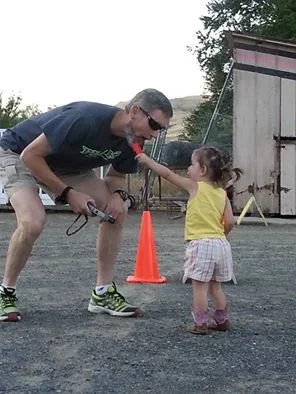
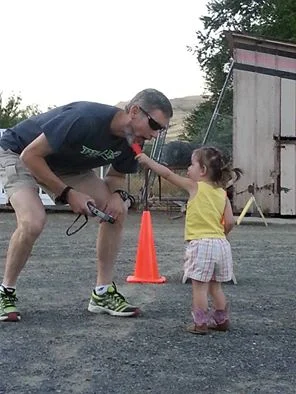
Time out on timing this summer to lick a granddaughter's popsicle. It was her first 5K.

Time out on timing this summer to lick a granddaughter's popsicle. It was her first 5K.

Oxygen is NOT overrated!

I did a workout years ago with a friend as we prepped for the Portland Marathon. He was supposed to be pacing me on a marathon paced run. Unfortunately, he's loads faster than I am (he ran a a sub-3:00 marathon to my 3:28) and the pace gradually drifted up to the point where I couldn't breathe. 

Not that I entered oxygen debt. I mean it more in the literal sense - I have exercise-induced asthma, the temperatures were in the low 30's, and the pace all combined to trigger an attack. 

Since I have my own little issues with breathing, I think it's important to pass on the knowledge to the junior high school kids I coach. Not the asthma part, the breathing part. 

Every year, I lead them through some exercises on breathing. Depending on how long the kids have been with me, we'll experiment with different things. This year, I had two runners that had been with us since the sixth grade and the rest were new to the sport. So I co-opted Thing 1 and Thing 2 to help the younger kids. 

First, at very low speeds we sent them around the Chief Looking Glass park with instructions to count how many steps they took per breath. A breath was a full cycle of inhalation and exhalation.

Then we sent them out to do it again, because combining activities for junior high kids leads to mass confusion - most of them lost count. And their form fell apart because they're not to the point where they can do two things at once - run and count - without one of them getting a little sideways.

At idling speed, Thing 1 (Carmen) was taking six strides per breath and Thing 2 (Maia) was taking eight. This was consistent with their training levels - Maia has been training hard for two years while Carmen is just starting to transition from running with sisters to training for races. 

The younger runners reported an average of four strides per cycle with a couple at six. 

We repeated the drill at several different speeds so they could get a feel for how their breathing changes at given paces. For a lot of them, it was an eye-opener. Natalie, one of the sixth-graders who also does martial arts, adapted the fastest. 

This comes to mind because I came across a book, Running on Air, that proposes to teach a runner how to breathe to maximize speed and endurance. Obviously, I've ordered it and it's on the way. I'll do a review once I read it.

The part that caught my attention was a proposition that the way we breathe and run is incorrect. Specifically, the use of even numbers which means that we always begin a breathing cycle on the same foot. Since belly-breathing loosens the core during an inhalation, this creates an imbalance that taxes the leg/side that begins the breathing cycle. 

Interesting idea, hence the ordering of the book. 

The other claim that was interesting was that the average runner uses about 60 percent of their lung capacity. Since breathing is always my limiting factor, it's an area where I have the greatest potential for improvement. I suspect that this is true of the kids I coach. 

The downside is that I don't think I can fully teach the ideas to the kids in the short junior high season. I can, however, introduce it to them and start the process. 


Might have to give up on a novel . . .

I'm in the midst of writing a couple of different novels. One, The Lonesome Mile, I had planned to set in Colorado. One of the  underlying themes of the story was the struggle that an aging miler faced with his own professional demise - and the allure of PED's to extend that life.

The coach in the story is a piece of work, a do-anything-to-beat-the-Kenyans type of guy. I don't know anyone like that, but that's why I write fiction.

Unfortunately, that whole story line blew up in the last month. First came the stunning announcement that Rita Jeptoo tested positive on her A sample. Then, the implosion of the Russian Federation athletes' doping scandal.

In a reprise of cold war rhetoric, Russian Athletic Federation president Valentin Balakhnichev said, “The federation believe the documentary was a provocation aimed at discrediting Russian sport.” 

So, national events have overtaken the basis for my novel. I can't claim to be surprised. I wrote about different aspects of the doping problem in This System Fails Kids. I also hinted at it in a more recent article, Here's how to get more media coverage for running - if you dare.

What I have to figure out now is whether this is still a story worth writing. My first guess is 'yes' but I'll have to do some modifications of the plot and perhaps shorten it to a long short story instead.

I do expect an avalanche of non-fiction to hit the shelves in short order. They'll give us the why's and how's, but I wonder how deeply they'll look at the emotional motivations of the cheaters and the systemic abuse of trust by the coaches of those athletes. If they don't, I probably will.

In the meantime, I'm working on a story that a pair of young ladies from Mead High School have asked for.

And we'll see. I really wish my story idea had stayed the stuff of imagination and fiction, not tawdry headlines, tarnished reputations, and tainted accomplishments.

Palouse Road Runners Book Club

Well, it seems a natural fit. The Palouse Road Runners, along with the Beer Chasers, have a book club that meets, I think, monthly. A while back I saw that they were tackling "Once a Runner" by John L. Parker. This month, the book is "What I Talk About When I Talk About Running" by Haruki Mirukami.

I'm reasonably sure that this is the first time that I have heard of a book club affiliated with a running group. That is a bit of surprise, because most of the runners that I know are also readers. (Yep, I know, anecdotal evidence and a small sample size.)

I read a lot of running books - this one has been on my list, so I should pick it up and perhaps join some other folks with aligned interests. 

Anyone else's running group have a book club? And, if you want to join in on the PRR club, they're meeting at The Daily Grind in Pullman on January 19th at 7PM - everyone is welcome.

End of the World Run, 2014.

'Tis the season and all that jazz. The End of the World run, which started with the Mayan prediction of a gloomy Christmas in 2012, is back. Saturday, December 20th at 10 AM. You have a choice of 2 and 5 miles. Click here for race entry forms. The race benefits Asotin Cross Country.

Yours truly will be handling timing duties. I may or may not have an assistant.

We usually have some prizes, too.