Welcome to Nairobi

After thirty hours on planes and in airports, waiting patiently in the passport lines, and discovering that my bag might well have been the first onto the plane – and, thus, the last off – I met Chris outside the airport for my ride to the quiet hotel I booked, sight-unseen, online. I did run into a slight delay at customs. The camera equipment had them questioning my tourist-y bona fides, as did the weight of the books in my suitcase. I explained I was a writer. That didn’t help. It took a little convincing before he understood I'm not a professional photographer who should be paying some sort of tariff fee. I think my cluelessness finally garnered a touch of sympathy as the agent eventually wearied, smiled, and waved me on my way.

Chris works for the Hotel Troy-Nairobi, which offers a shuttle service for a nominal fee. I contacted them before I left and Chris, a tall-ish gentlemen stood with a sign with my name to greet me at the street. Ten minutes later and with the bags loaded, we departed into the dark for the hotel.  (Side note: Chris oomph’d at the big bag - For those who are fans of It’s a Wonderful Life, think of the scene where Jimmy Stewart is talking about the suitcase he needs, one big enough for all the stickers for all the places he’s going that can double as a life raft if the tramp steamer he’s riding goes down. That’s about the size of my bag. For much the same reasons.)

On the drive, I noted that Chris maintained a pretty steady 100 kph (about 60 mph) despite the flashes of what I took to be radar cameras. I asked, and Chris confirmed. Yep, they were speed traps but the government put the system in without penalty for the first year to get the drivers used to the notion. Strikes me that the government might be training them to ignore the cameras at the same time the drivers ignore the 50 kmp speed limit, but we’ll see, I guess. The Kenyans also drive a bit like the Koreans I remember. Painted lines are strictly advisory in nature.

Check-in was a breeze. It took a little trial-and-error to find the correct room, not that the hotel has many. The original room they set aside had an issue with hot water at the shower. The showers use an on-demand system that’s kind of neat when they work. The one in the first room didn’t, so we did a shift two doors down. I FB’d family that I was alive and crashed.

With my body clock a touch confused, I woke at about 5AM, Nairobi time. Interesting little fact. The folks here don’t get moving that early. I ended up taking a walk while I waited for the breakfast to open at seven.

The Hotel Troy-Nairobi sits on the outskirts of Nairobi with Nairobi National Park across the street. I meandered my way to the northwest and managed to see a monkey in the trees of the park. No bueno on getting a picture – the critter was moving pretty quick. I wasn’t.

Also moving quickly were the legions of men walking to work, some singly, some in clumps of two and three. The ones headed in the opposite direction mostly smiled when I said hello, though a few looked confused and one downright bemused. I gathered that I was not exhibiting typical behavior for a tourist.

Hotel Troy does not believe in allowing guests to be hungry. Breakfast was a Spanish omelet, a sausage of the type the British call bangers, potatoes with bell peppers and red onion, two rolled crepes, and beans. Plus watermelon, juice that I think was passion fruit – the taste was familiar but not from recent memory – and cups of tea.

Then, I went for another walk. This time, I aimed for a destination. The Galleria is a shopping center that would fit in most mid-size American towns. They had exactly what I needed. A phone, since Verizon doesn’t work in Kenya, and an adapter for my computer. The Kenyans clearly have not grasped how to be rapacious in their phone contracts. The phone was cheap, the minutes pre-paid, and no sell-your-soul-to-the-devil service contract. The people in Safaricom were also unfailingly polite, though they could speak up a little.

Little fact that most Americans don’t know. Kenya positively kicks our butt not just in running but in the use of mobile money. The program, M-Pesa, allows you to load money onto your phone and use it at merchants in the place of cash. Kenya is one of the leaders in the world at adopting this technology. Safer than carrying cash and more secure than a credit card, M-Pesa is a fundamentally different way of managing economic transactions.

A cynic might point out that the mobile money system would work in our country if not for the lobbying of the banks and credit card companies.

Nonetheless, M-Pesa is a godsend for travelers.

The Galleria had a bunch of other shops, too. I found a camera shop where I can get some new filters if I need them. A pharmacy and doctor’s office, both of which I hope to avoid. A book store. (natch!) A brewery that looks right intriguing. A Kentucky Fried Chicken place complete with a huge picture of Colonel Sanders.

In a major score, I found a bicycle shop that rents bikes for day use. I figure I’ll rent one in the next day or two and go on an impromptu bike tour of Nairobi’s environs. I brought a backpack so I can hump water and food to make a day trip of it. The lack of a map might be a bit of a hindrance, plus I need to remember that the Kenyans drive on the opposite side of the road. Still, I hadn’t thought of exploring on a bike.

Okay, that’s the update. I’m running eleven hours ahead, so it’s lunch time for me. Time for another walk, this time east-bound. I heard there’s a restaurant not too far away, one that doesn’t feature American icons.

First run will be tomorrow morning, before the heat – and traffic – comes in.

Can you tell Christmans is near?

New Blogging Adventure

Sorry about the infrequent blogging, everyone. With Christmas fast approaching, along with my trip, the days stay filled and I haven't carved out time for writing much of anything.

Seemed like the perfect time to commit to more writing, so I am very pleased to announce that I will be doing book reviews (on an irregular basis) over at BookHorde.org. By now, you've gathered I read quite a lot. Most of that I do not review on this blog, though I am reconsidering that thought.

Book Horde is a newer book review site, committed to bringing attention to emerging writers. As readers, we live in the greatest age of story-telling that has ever existed as authors, including yours truly, begin to see the power of self-publishing. Therein lies a problem, though - separating good work from bad. Book Horde, like many of its fellow review-blogs, pans for the literary gold for you. (Well, maybe not literary - they reviewed Trail of Second Chances (and liked it a lot!), but you get the drift.)

I'll be putting up reviews on sci-fi, fantasy, and thrillers. Since I'm involved in some writing groups, the range could conceivably grow to include genres I don't normally read. We'll see - it's an interesting adventure.

Old Blogging Adventure

I've talked to quite a few people recently that lamented the fact that I didn't blog over at InlandXC this past season. The principal reason wasn't a lack of interest, but of time. The original intent of said blog was to cover races in the inland northwest. That's too big a territory for one guy with a full-time job, coaching responsibilities, writing addictions, and family obligations.

I need help. (No, not mental help. I'm happy, I'm harmless.)

I am looking for people interested in contributing on a regular basis, in season, to the site. Ideal candidates are high school students who would like a byline and a snazzy looking reference for college applications. Proficiency with English is a plus. I think I have someone in Pullman who might be interested. Could use a couple of someones in the Spokane area, and the Tri-Cities area.

Notes About Kenya

Prep work is done with the exception of packing and buying Traveller’s Checks. (Just realized that my internet browser spellcheck is set for English English, not American English. Colour me embarrassed.)

Justin Lagat got hold of me to let me know that the NIKE Discovery Cross Country race will be in Eldroet while I'm there. That will be exciting to watch. He's also trying to arrange some interviews for me, which will help me cover the spectrum for my book.

Or books. I might try and do a non-fiction book out of this whole experience, too. In any event, I will be posting to the blog as frequently as internet connections permit. Expect plenty of photos as well.

In checking the various embassy warnings about Kenya, it appears that the area up on the Somali border and the area along the coast are relatively hazardous for westerners due to the risk of kidnapping. Fortunately, I'm not headed to either of those locations. Still, there's plenty of good advice available. I check in with the American State Department, as well as the Canadian Embassy and the Australian Embassy.

Kenya also has quite a few English-language newspaper online. The two that I have been reading are The Daily News and the Digital Standard. Both have pages devoted to the areas that I'll be traveling.

Having Justin there to point out when I might be doing something dumb will be a big help. I'm pretty good at dumb-but-survivable mistakes, but that's within my current experiences.

From here to Christmas, I'll probably put up a couple more posts, but I'm not going to try to hold to the normal two-a-week schedule. Family time is important.

Take care, run gently. Or get caught up on shopping. Or hanging lights. Or spiking the egg nog.

2015 B.R.A.G. Medallion Honoree!

I received an email yesterday that Trail of Second Chances has been awarded a B.R.AG. Medallion. The award is given by IndieBRAG, a site dedicated to helping separate the cream at the top of the independent publishing world. Based on their criteria (plot, writing style, characters, copy editing, dialogue, cover/interior layout), ten percent or less of the books they review earn a Medallion.

Their last criteria is the 'would they recommend this to a friend' standard. Personally, for all the complexities that go into creating a book, both the writing and the production, this is the test that I like best. I don't buy books to put them on the table and impress people (unless folks get impressed by the sheer number of books) but to read and share. The sharing lends almost as much pleasure as the reading. 

I am very pleased to be a B.R.A.G Medallion Honoree, to say the least.

For those of you who like to read and have a hard time coming up with new books, take a look at their website. They've done a lot of the curating so you don't need to worry about buying a dud.

In related news, the incomparable John L. Parker, Jr gave me a blurb for the audiobook version of Finishing Kick. When I wrote the book, I intended it to be the high school 'girl' version of John's Once a Runner. As a natural tie-in, he would have been one of the first people I should have contacted about the possibility of reading it. Except, in a rarity in my life, I didn't have the guts to send him a letter and a copy of the book.

I met John in Eugene earlier this year, along Jack Welch and a host of others, and about the third day there, told him that story. His response was a laconic, "You should have." So this time, I did. This is what John sent back:

Paul Duffau knows cross country inside and out, and he knows how to tell a story. I can't imagine a high school runner--or any runner for that matter--who won't keep eagerly turning pages to find out if the charming and enigmatic Callie can find a way to dethrone the haughty know-it-alls from Fairchild Academy. This is a wonderful coming of age tale as well as an exciting sports story. Highly recommended!

Not all of that will fit on the audio cover, but I'll be updating the print copy of the book, and you can bet it will make it on the cover there. When one of the folks that you truly respect give you an 'atta-boy', it's a definite boost to the ego.

The audiobook will have a cover that is dramatically different from the print book - the design differences are interesting enough that I think I'll be querying some of the leaders in the field about them. We are on schedule for a release on the audiobook in the next week or so. I'll pu the new cover up when I get it finished.

It's snowing today in Asotin. Not much, but white, cold, icky. It was in the seventies in Eldoret with afternoon thunderstorms. I know which I prefer.

Interview with Author Robert Coe

I thought that with the current issues raging across the country at our various institutions of higher learning, it would be interesting to discuss the developments with someone who experienced the most notable period of upheaval on campus. Please greet Robert Coe, author of Jock: a memoir of the counterculture.


Paul: Your book, unlike most in running, is a big sprawling work that puts running into the context of both the lives of the athletes and into larger interrelated communities. As a writer, I think it was an interesting decision to make. Why did you?

Robert: I realized there was no literature out there that placed not just running but major college athletics firmly in the context of the Sixties, in my case also bleeding into the early Seventies.

I wanted to write JOCK the way I did because somehow the idea had accrued that in the era of Muhammad Ali’s draft resistance and “Broadway Joe” Namath dating Janis Joplin and calling a Super Bowl victory and anti-Vietnam War disruptions shutting down 442 college campuses nationwide in 1970, including Stanford’s -- that somehow this volatile era barely touched college football and swimming and Track & Field and cross-country; that being a “Jock” somehow left you pure and unaffected, or maybe even back in the Fifties yourself. Much of Stanford Track & Field did remain mired in the Fifties, with Coach Payton Jordan running the program and requiring everyone to have short hair and proselytizing for his conservative version of the American Way and employing all kinds of outdated training methods in virtually every track and field event you could mention. (For distance runners it was “Intervals, Intervals, Intervals.”)

But our cross-country team was its own little counterculture. Not that all of us were stoners – in fact most of us weren’t – but we were running against the way things usually worked in college athletic programs. We were pretty much on our own, working under a great Coach, Marshall Clark, who understood Arthur Lydiard’s maxim “Train, Don’t Strain,” where the previous head of the program had lived more by the rostrum, “No pain, no gain.”

Many Stanford athletes, including players on our two winning Rose Bowl football teams (the first one led by Heisman Trophy Winner Jim Plunkett), understood that all of us were up to our eyeballs in what was happening in the world, whether we liked it or not. And anybody who didn’t think that way couldn’t have been paying much attention. Even Plunkett said it wasn’t an easy time to focus on a game.

Paul: You were around the running world about the time that the athletes began to rebel against the AAU. Was this an out-growth of the times, a milder version of the counter-culture, or simply people finally awakening to the unfairness of the AAU system?

I was more or less oblivious to the events going on at the level of the A.A.U. Our sport was a shadow of what it is today. When I set a new Stanford freshman school record in the Mile (4:09.5), I was unaware of any youth development programs anywhere in the country that I could have pursued in the summer, although I subsequently learned there were a few.

As far as rebellion goes: in my case I had many “culture wars” with Coach Jordan, the Head Coach of the record-setting 1968 Mexico City Olympic team, over-- get this – my hair. It’s all in the book. In the end I would usually follick-ly conform, but I never enjoyed these confrontations. Weirdly enough, I was one of Jordan’s favorites. He nicknamed me “The Baby-Faced Assassin.”

Paul: In your memoir, you compared the T&F team to 'labor'. This past year, the athletes at Northwestern sued to be able to form a union. They were rebuffed by the courts. What do you think of the current relationship of student/athlete to educational organization and how do you think it may have changed from your time at Stanford?

Robert: I used that term “labor” only once, referring to a terrible incident in which one of our teammates was struck in the temple by a thrown discus during an official team practice in the stadium. Discus throwers were allowed to throw on the football grass while their teammates warmed up in preparation for running, jumping, vaulting, etc. We were warned simply to “pay attention; be careful; watch out; keep your eyes open.” It was an accident waiting to happen, and when it finally did happen, with truly horrible results – our teammate permanently lost the sight in his right eye – I told people that “we” should never have allowed this practice to continue. We were “Labor.” We should have organized and as a team asked the Athletic Department to find another place for discus throwers to practice.

But to directly answer your question about today: I get a sense that there is a great deal of harmony now between athletic teams and the athletic department. I hear through the grapevine various grumblings about the basketball coach and football coach David Shaw’s conservative play-calling, but them’s peanuts. The success of the Stanford Athletic Department is incomparable to any in the history of college sports, and I think harmony is part of the reason why. The other part is the enormous financial resources at their disposal.

Paul: A portion of the Missouri football team went out on strike and refused to practice over issues of perceived racism at the university. They won. Could that have happened in 1968-1972 with the Stanford team? What would have been the reaction of the university and the public?

Robert: I knew Black football players who felt that “Indian” Coaches – we didn’t become the Cardinal until the fall after I graduated, meaning I and my classmates Black and White spent our whole careers on a team with a racial mascot -- treated them like machines, expecting them to return from injuries more quickly than white players did.

Two days before the Stanford-Michigan Bowl game, my friend, the workhorse fullback Hilary Shockley, quit the team, despite a personal appeal from Head Coach John Ralston. “Shocker,” who had played the whole season with painful bone chips in his ankle, reportedly told his Coach, in a word-play on our head trainer’s constant refrain– “You can’t make the club if you’re in the tub” --“You can’t hit the field until you’re healed.” (Shocker was a walk-on, like I was; he went on to Harvard Business School.)

There were many racially-tinged events during my era. My 1968 entering class of 1,447 students was (according to the school newspaper) 85% Caucasian, 6-7% “Oriental,” 5% “Negro,” and the rest Mexican-American, Filipino and “American Indian.” (The Daily failed to mention we were also about 2:1 male, and Title IX was still a pipedream.)

A year-old Black Student Union was demanding the formation of a Black Studies program and expanded admission and financial aid for minorities. My freshman English instructor had us read Eldridge Cleaver’s Soul on Ice, which he described as a work of “genius.” The racial pot wasn’t just bubbling, in other words; it was boiling.

The only incident of refusing practice I ever heard about came when players in the first Rose Bowl camp, Black and White, gathered in the locker room before one of their hated morning practices and decided that since they were going to be playing in a Rose Bowl Game in less than a week, by god they were going to have fun. So no more morning workouts! “Boy-cott Prac-tice, Boy-cott Prac-tice!” I don’t know if anybody actually chanted that, but a Sixties-style “People’s Revolt” had definitely reached a Rose Bowl football team. And I give it up to John Ralston: he gave in to their demands. He even arranged a field trip to Marineland.

Paul: The racing world is in big trouble as the doping scandals continue to widen in scope. How would a 1968 Robert Coe have reacted to the pressures of today's racing environment where the phrase “the winner is the guy with the best doctor” has gained currency? Would you have competed or called bullshit and walked away?

Robert: As I mentioned in JOCK, I was in an era that was almost pre-doping. PEDs were something new in the lexicon of sports. Olympic drug testing had been instituted for the first time in Mexico City, where Coach Jordan had been a vocal and sincere opponent of drug use: an honest-to-god believer in those “precious bodily fluids.” But testing methods were crude, and rumors of abuse by major U.S. stars were widespread, although without hard evidence to back them up.

To the best of my knowledge, Performance Enhancing Drugs never touched Stanford’s athletic programs at all while I was there. Stanford Quarter-Miler Jim Ward, Jordan’s 1968 Track Team Captain, would later claim that all six runners who finished ahead of him in the N.C.A.A. 440-Yard Championship Final in ‘67 were doping, and that his friends at U.S.C. and U.C.L.A. were given PEDs like candy from training room dispensaries. Maybe there were scenes at Stanford I didn’t know about (although I doubt it), but in an era that introduced a number of innovative approaches to training, encompassing not only drugs but also the human potential movement, I saw evidence of neither in Dave's Animal Kingdom. That was what I called Head Trainer Dave Blanchard’s Training Room. Except for the assistant trainer Scotty, who was a very cool guy, the Stanford Training Room was about as retrograde a scene as you could find on campus in my era. But to answer your last question: if doping had been around, I am quite certain I would not have done it. Yes, I definitely would have walked away. Not for health reasons, although those would have been reasons enough. Cheating violates everything I felt about our sport.

Paul: As we get older, I think we all become a little introspective. Some look back and decide it was all worth it, each bump and bruise. Others play a game of 'what-if'. Where do you land, in life and in running?

Robert: I write in the book that I simply closed the door on that chapter of my life. Injuries and illness kept me from becoming the runner I might have been. But then again, I quit at the age of twenty-two. Kenny Moore, the two-time Olympic Marathoner and Sports Illustrated track scribe for three decades, who I knew slightly back in the day, read JOCK, and among other things wrote me this: “You might not regret ending serious racing, but I do for you. I can clearly imagine you and me continuing our talk about the meanings and paradoxes of sporting effort, community and service, and me inviting you to train in Eugene after the '72 trials. Where I would have tried to shake you out of the provably erroneous assumption that four college years were all you were allowed for a career.”

From the current perspective of these many years, I think I would like to have seen what I could do. But forgive me if I quote from my book:

“My portrait hung in the Stanford locker room for nine years! I raced against Frank Shorter, Gerry Lindgren, Martin Liquori and Steve Prefontaine, and in meets with Bob Seagren, O.J. Simpson, Lee Evans, and John Carlos! I led Pre for 800 yards in the 1971 Pac-8 Conference Mile! Before the first race Jim Ryun contested as a Born-Again Christian, I was dragged off the track in the Devil-Take-the-Hindmost Mile! I could run a 50-second Quarter and also out-race long-distance All-Americans and Olympians, past, present and future! I logged thousands of miles with some truly great runners [including Don Kardong and Duncan Macdonald] and aspired alongside them to national championships! I competed for the London Track Club at the Crystal Palace and at the Oakland Coliseum and San Francisco’s Cow Palace for Stanford! I trained on trails in the Sierra Nevadas and on the track at Berlin’s Olympiastadion! I coursed through the cypresses of Point Lobos and risked my life running along the Rhine! I was a forest creature in Munich, a Yank between the hedgerows of the English countryside and on the cobblestones around Buckingham Palace, and a hippie running naked on the beaches of the Costa Blanca! When the great Australian Ron Clarke set his last world record [over three miles indoors], he flung his arms around my neck and said, ‘Thanks, mate!’ I was present at the births of West Coast cross country and the West Coast Offense! I had been there, and done that. But I also decided early on that my book would no more grovel over my victories than it would trade in my long-vanished defeats. What I wanted to do [with this book] was open a window on an era, and confirm that I felt like the Stanford All-American basketball star Nneka Ogwumike did when she addressed a crowd at Maples at the end of her final college season in 2012: “I wouldn’t have traded these four years for any other place with any other community, any other team, any other coach.”

Paul: What memories of running and racing at Stanford mean the most to you?

Robert: My teammates and our Coach; our long training runs and tough interval sessions; and our amazing competitions. I refer frequently to a line from Kipling: “The strength of the wolf is the pack, and the strength of the pack is the wolf.”

  1. What advice would you give a freshly minted high school graduate who's headed off to race in college.

Robert: All that really comes to mind are clichés, most of which contain a germ of truth. So here goes: stay hungry. Feed your passion. Keep an open mind and heart. And train, don’t strain!


Jock: a memoir of the counterculture - a review

Those looking for a 'pure' running book will find it in Jock: a memoir of the counterculture. With Robert Coe's careful eye, you get a stunningly detailed look into the life of a competitive collegiate runner during one of the most tumultuous phases that the United States has endured. However, those looking for only a running book are in for a surprise as Coe takes us on a journey through the late-sixties and into the seventies.

Most running books focus on the how-to of running, and a few comment on the history, but Jock seeks the totality of the experience. Set at Stanford from Coe's first days entering the campus to his final year, the narrative winds through the cross country season to the classroom, out onto the track, and eventually as far away as Stanford-in-Britain.

Coe's journey is neither smooth nor straight, as befit the period in which he compete. His recollections of the protests on campus and the reactions both the rank and file students and the student-athletes. He's honest to a fault, showing that there was no unified front – some athletes were supportive of the administration of both the university and the country, even as he and many others were not. Coe does not pull punches. If he felt a particular individual deserved approbation, he delivered it, often in spades, as his descriptions of head coach Payton Jordan make abundantly clear.

Yet that is balanced by the clear pleasure he derived from his teammates. A storied cast that included luminaries such as Don Kardong and the immortal Ron Clarke populate the book, lending it an indefinable air of groundedness. Running at the leading edge of the boom to come, he recounts competing against Pre and the other Ducks, the icy crap that he ran in at WSU for the Pac-8 championship, and the records that seemingly fall with every page. Coe's tales of the training runs, the effort that went into training, are worthy of a book of their own.

Yet, side-by-side to that, are the stories of drug experimentation, the nascent hook-up scene, and a culture that was in a state of upheaval in which every rule could be, and often was, called into question. Coe gives an honest accounting of that, too, both of his own activities – yes, he experimented - and that of the late sixties. He joined some of the protest marches, investigated the claims and counter-claims, and grew into an adult seasoned by the experience at Stanford and in Europe during a pivotal sophomore year.

Where all the other legends get pared down to the feats on the athletic course and sanitized to make them orthodox, Jock looks at the life of the athlete from an intimate perspective. Unlike the tightly controlled legend of Prefontaine, Coe ranges far and wide in an authentic effort to provide sense to running as it related to the age. In this lies the meat of Coe memoir, a blatant openness that peels back the veneers to expose the vicissitudes of the protest generation.

For a person interested in more than a running book, Jock: a memoir of the counterculture delves into the running even as it touches, in first-person detail, history.

PS. On Tuesday, I'll be posting an extended email interview with Robert Coe!


Paul is the author of two fictional tales of runners: Finishing Kick (recognized by Running Times in their Summer Reading list July, 2014); and his newest novel, Trail of Second Chances. He blogs on the running life and interviews people that he finds interesting.

Fixing the Disparate Impact of 1B/2B Cross Country

Something that disturbs me every year is watching the 1B/2B girls lining up to race and seeing how few toe the line. To put it in perspective, 73 girls ran this year. The boys field saw 141 racers. This doesn't represent an anomaly - the same thing happens every single year. The numbers over the last four years are: 73/141, 66/137, 72/125, 62/129. I could go back further in the records but that rough 2:1 proportion remains.

Relative to the remainder of the divisions, and even compared to the 1B/2B boys, a smaller percentage of qualified female runners get the opportunity to run at the Washington State meet. I'll get to what I mean by qualified later. I'm afraid that there will be some math, but nothing complicated. Promise!

I finally had time this year to do some research. I used the numbers from Athletic.net to generate my statistics. The numbers inside the raw results were fascinating and when broken out, indicate that the best way for a 1B/2B runner to get to State is to be male. Given all the Title IX implications, I was surprised. So, to the numbers. . .

Entries to the state meet are based on an allocation model devised by the WIAA. Each division and district gets a set number of teams that can advance from the regional meets to the state meet. Individuals can qualify if they place in the upper bounds of the runners. This bound is defined by the WIAA as the team allocation times five.

For District 7/9 here in Eastern Washington, our allocation this year was four. Asotin, Reardan, Northwest Christian Colbert, and Tri-Cities Prep all had teams make the cut. The meet also had twenty individual slots (4x5). Those slots are not reserved, though. Any person finishing in the top twenty filled one. So, from this meet. nine girls went as individuals with the other eleven spots taken by runners from the qualifying teams. For District 1-4, the allocation was for three teams and fifteen girls. They had five individuals crack the top of the standing to get to state. District 5-6 got one team, five girls total. Three of the top five were not on the winning team and moved on. Each team is permitted up to seven competitors which swells the ranks of the field a bit in favor of the teams.

The total number of allocations for the girls is eight. For the boys, the allocation is sixteen. Part of the reasoning for the difference is that more boys participate in cross country than do girls. The numbers at Athletic.com back this up. Based on their numbers, there were a total of 468 boys in the 2015 season versus 217 girls. Seems to support the case for halving the field of runners on the girls side at the superficial level.

What the raw number does not tell us is why there should be such a discrepancy. While it is true that the participation rates for females increases with school size, to have 1B/2B cross country get less than fifty percent rates of the boys rate suggests that other factors underlie the issue.

I dug deeper, looking specifically at the individual qualifiers. That when I thought things got quite interesting. I looked at this past season and found that the last individual girl qualifier, Jessica Mitchem of Toutle Lake, finished in 47th position. In percentage terms, she finished at the 64th percentile (with State Champion Madie Ward at the 1st percentile.) Performing the same calculation on the boy's side had Gunnar Johnson in 122nd place, and at the 86th percentile.

Compared to her male counterpart, Mitchem had to a better runner relative to her peers. I did the same calculation for the preceding three years and found the same result. The boy's value was always higher than the girl's. I had to go back to 2011 to find an example of the girl under-performing her field compared to the boy, and in that case, the girl ran three and a half minutes slower than her qualifying race, suggesting she was sick. 2010 saw a return of the pattern.

So, in the matter of individual qualifiers, the selection process obviously weeds out girls that would be as competitive in their field as their opposite number would be in the boy's field. Remember, too, that the boys get twice as many teams, which means that more of the girls qualify individually. Six of the top eight runners in District 7/9, for example, were individual qualifiers in arguably the toughest 1B/2B district in the state. (Eight of the top ten finishers came from that district in 2015.)

Even more interesting to me was the median pace. I looked at this to see whether there might relative movement in the quality of the runners. I chose the median versus a mean to remove the outliers such as a Chandler Teigen dynamiting the state record or the afore-mentioned young lady who ran while ill. I looked at four years, 2012-2015 (representative of one high school 'generation') and found the boy's to medians to be 18:44, 18:31, 18:22, and 18:44. Pretty much a flat line with what appears to be normal deviation.

The girl's results for the same period: 22:27, 22:45, 21:54, 21:42. The girls aren't flat-lining, their flat getting faster.

I contacted Andy Barnes from the WIAA who was listed on their website as the go-to person for questions regarding allocations. In the first email, I just asked for information on how the allocations were assigned. Between email exchanges, I had started to look at the breakdowns a bit more thoroughly. Andy sent me a prompt reply that it was based on the participation rates within the divisions by teams, suggesting that the individual component was not addressed.

I checked the information on the site as Andy suggested and sent a follow up.  I did not send him the full data, just pointed out the disparity that I was discovering. I also suggested a potential remedy that would not otherwise reduce the speed of the field:

Andy,  

Digging into the numbers, it appears that the depth of the men’s field is extended by the individual allocations (the lowest boy ran in the 86th percentile) while the girls field does not get that same benefit (the lowest girl ran at the 64th percentile.) This would appear to restrict the participation rates for the female athletes of comparable ability to their male counterparts.

Wouldn’t it make sense to try to increase the participation by increasing the individual qualifier slots to fill out the middle of the pack. The additional individual qualifiers would maintain the overall speed of the field while serving to increase the competition for the middle of the pack, advance the opportunities for the girls, and perhaps encourage more participation at the small schools. For example, opening the individual qualifiers to 20 in District 4 would have resulted in three additional girls at the meet, all of them freshmen and within the upper two-thirds of the overall field. I think you would agree that the chance to earn a spot at the state meet can be a powerful motivator and that success for one athlete can encourage others to follow.

I would be interested in your thoughts.

Andy responded again. Here is the text of that email:

Paul, you have obviously done an extensive review of the entries and we appreciate that.  However, the member schools believe that the process outlined in Handbook rule 25 is the process they wish to use for state tournament entries.  

Every year the rules of the Association are reviewed including the Allocation process.

If you feel that a change is necessary I suggest you work with your local school to suggest a change to the current process.

Let me know if you have any questions.

I understand the position of the WIAA in that they need to have consistent rules, and I further understand that Andy is standing up for the process that they have in place.  Where I suggest a problem exists is that they have a process that can be documented as creating a disparate impact on female athletes. In this day and age, not to seek to proactively correct that seems unfair and outside of the WIAA’s stated core principle of “Provide access to equitable, fair, and diverse activities.

For a female athlete who is young and on the cusp of qualifying, especially those who run without teams to provide encouragement, missing the state tournament could easily be demotivating. To have to meet a higher standard than a male adds injury to insult and is not equitable.

While it would increase participation, I do not believe that the solution is to add more teams. The net result of adding teams would be to slow the entire championship field. Most athletes perform better in direct competition. With a field as strung out as the 1B/2B girl's race, most of the athletes are running on islands as it is. A better solution, one that increases the level of competition in the middle of the pack, is to increase the number of individual qualifiers. 

I went back to the regional races to see what impact altering the allocation schedule to the number of teams, plus one, times the five already used by the WIAA. The net result? Six additional entries into the state race. From District 6, Caitlyn Ball (Riverside Christian), Katie Henneman (Tonasket), and Victoria Cole (Riverside Christian) would have joined their fellow athletes in Pasco. The other three come from District 1-4, Sarah Loven (Mossyrock), Amelia Kau (Orcas Island), and Meleah Kandoll (Toutle Lake) would be in. In the hyper-competitive District 7/9, no additional qualifiers would have made it out of the regional.

The last of the six, if they ran to form, would still be slightly ahead of the boy's equivalent, but the overall disparity would be in single digits from a percentile perspective. In the case of Kau, she would have likely placed similarly to teammate Stephen Hohman. Why should he go and she's done for the year?

Another factor is that four of those six are freshman and the other two are sophomores, exactly the kind of developing runners we should be encouraging. Qualifying for state, legitimately, is the ultimate encouragement. And, to the girls around them, inspiring. One of them just might decide that "if 'so-and-so' can do it, so can I."

Why, the next thing you know, the participation numbers just might grow. Wouldn't that be great?

38 Days and a Wake-up

It's been a long time since I've been in countdown mode for a major trip. I started actively planning for the trip six months ago when I bought the plane tickets. I had loads of time to get everything set. Good thing, because my Kenyan adventure is rushing at me and suddenly time is at a huge premium.

I still don't know all the places that I will be going for the research for the books. Some of that I'm going to have to play by ear once I get there. Some of that is because I haven't gotten responses from some of the men and women I hope to meet while I'm in Iten. Those will get worked in as they fit. I'll also be relying a lot on Justin Lagat to help figure out where I need to be to get the background for the stories.

I've started handing out letters to the Realtors I work with to let them know when I'll be gone and when they can expected me back. The response has been two-fold: first, an upwelling of best wishes; and second, a question of who they will to use while I'm gone. It's nice that they're going to miss me on a professional level. One fear that still niggles at night is that I'll come home and find I killed my company.

The family is in a different count-down mode. They have a dual count-down. When does he leave? And how soon until he gets back?

The recent news from Europe hasn't helped soothe their anxieties and the average perception of Africa is colored by the political events in the Middle East and the Ebola plague in West Africa. It probably doesn't help that I joke about getting pictures of the charging lion that eats me.

Telling the kids and my wife that Kenya is safer than Chicago doesn't really work either. People always fear the unknown more than the daily dangers that exist around them. The risks differ here. A random car accident or bear sighting is relatable from past experience. Kenya offers a laundry list of unknowns, from the people to the environment to the animals.

Still, that's not their biggest issue. The kids are long on faith that I can take care of myself in a pinch.

The biggest issue for the girls is that, for the first time in their lives, Dad isn't going to be right there, just a phone call away at most, an hour drive at worst if they need to see me. (Though I probably will be just a call away - phone calls from Kenya to the States are pretty inexpensive.) All three of the girls are used to getting a call from me at least a couple of times a week. There are times where I think they find it annoying, but if I go too long between calls, I get questions asking why I haven't been checking in. Since the girls live nearby, we (Donna and I) see them and their families often.

 Now, I'm going far, far away. To a place that they cannot relate to - it's too removed from their life experiences. (Mine, too, if I'm honest.) So, they worry.

I have no words that can remove the worry. I wish I had.

All I can do is promise to be careful. On the last day of that second count-down, the when is he coming home one, I'll be on the plane, headed their way.

"So what is your degree in?"

Taking a diversion from running today and visiting on the work side of my life. For those who don't know, I'm a home inspector, the guy who squirms his way through a crawlspace and clambers through attics to get you good information on that dream home you're eyeing.

It's a very cool job. I get to see how other people live, how they design, what they consider priorities, all by looking at their houses. Now, I do have a few rules. When I'm in the closets, for example, I pay attention to the closet, not to the belongings. Ditto for the kitchen drawers and under the sinks. Never, ever, do I violate a person's privacy by intruding into dressers and the like. (And yes, I have heard stories of tradespeople doing exactly that. They should be banned from the trade/business if caught.)

I also don't judge people on the basis of their homes. I've had more that a few women - it's always the women - who apologized the condition of the home, despite the fact that it doesn't look bad to me. My standard response is that anyone with kids and dogs gets special dispensation. For homes that don't have the kids or pets, I point out that I have done frat houses and sororities - they're golden.

Yesterday, my afternoon inspection was twenty miles outside of Lewiston and into the hills above the Clearwater River. The home sat on 78 acres with riveting views from its perch above the canyons. The buyer and seller were both there, which is a bit unusual, but this was a For Sale By Owner transaction. FSBO's are almost always more relaxed than a traditional sale for both parties, and definitely for the inspector. Normally, I am bound by rule not to divulge my findings to the other party; with FSBO's, they both accompany me and we chat about the various issues as we discover them.

The buyers were from Moscow, home of the University of Idaho. As happens often, my clients were brighter than I am. That's the drawback to spending a lot of time with people with PHD's. The advantage is that I learn something new nearly every time I'm with people such as these.

And, as happens often, I got the question: so what's your degree in?

I get the question because the skill set for a home inspector, much less one that also coaches and writes, is a diversified set. Recognizing zebra stripes on the wall as indicative of minimal insulation, or being able to describe the function of an air conditioner (not that I could repair one - that requires manual dexterity, too), or understanding and communicating the potential for a carpenter ant intrusion takes broad knowledge across multiple disciplines. The breadth of knowledge greatly exceeds the depth of same. Home inspectors are the ultimate generalists. The best of us are able to synthesize two or three relevant observations do determine system failures that are not readily obvious. 

To answer my client's question, I told him quite simply, "I don't have a degree." I've told the kids in the AVID program at Clarkston High the same thing.

Still, I've always been an active learner and, as Louis L'Amour pointed out in his book, The Education of a Wandering Man, a person can become very educated without stepping foot in the halls of academia. As he also pointed out, that particular route of self-directed learning should be undertaken only by those with the self-discipline to stay the course.

In the course of my life, I've had the opportunity to work in many different fields, from shovelling manure for a buck an hour, to flipping burgers, to driving truck, to sales, to code inspection, and to home inspection, with professional writing as the next stop. Each taught me new skills. (Even shovelling manure - I learned to grow tomatoes and onions from that old couple, and got my first marketing lesson at their little roadside knick-knack shop.)

I have always read, too. I average more than fifty books a year and would read more if I ditched the computer and political blogs. For about a two decade stretch, I read non-fiction ranging from biographies of civil war generals and the Tudors, to quantum field theory (as much as I could handle with my limited math - I'm good into calculus, but some of that stuff is deep) and Gell-Mann's the Quark and the Jaguar. I'd binge read fiction when I needed a mental vacation, sci-fi before it went stupid, thrillers, mysteries, the occasional 'good' book that the college professor would proclaim as 'literature' which I always thought was an arbitrary standard.

I will be the first to admit that I have led a fortunate life. I was born in a country where a person is allowed to better themselves. That is not true of most of the world, and while people decry the lack of opportunity in America, it's still here, though there's a catch: you have to be willing to work and to learn.

More importantly, you have to believe. Believe that opportunity still exists, though the larger society will claim the American Dream is dead. It isn't, not as long as life stories like Ursula Burns or Ben Carson exist. The distance that they travelled is far greater and far rockier than the path the rest of us complain about. See the opportunities, not for taking advantage of people, but of learning and serving because that's the home of opportunity. My vocations and avocations a

Believe in the people around you. We're all part of a tribe, even a loner like me. Find your tribes - you probably belong to more than one - and find ways to contribute.  I had a person who once told me that I trusted everyone (true, at least at first) and that I never got burned by it in a major way (also true.) His complaint was that he'd keep score with people and always ended up getting screwed. It wasn't fair that I did the opposite, with the opposite results. I don't think he saw the larger picture. Believe in people, meet every stranger as a friend. The people around you will surprise you with how much they actually care and how much they will help.

Finally, the hardest step. Believe in yourself, both as you are now and how you want to be. I can't offer many guidelines on this one as I don't know them. There may not be a pat answer. In my life, I try to surround myself with good people, positive of mind, that will ask of me my best. I always seek new experiences and chances to expand my knowledge, whether it's via a good book or a chance conversation.

And, I think indirectly, my client gave me a better answer to the question of my degree during our conversation yesterday.

My degree is in the Practical Applications of the American Dream.

Run gently this weekend, friends, and find a good book or buddy to spend some time with, too.


Opportunity Takes Its Time

Couple of fun stories, non-running related, from the State meet this weekend.

The first happened Sunday while waiting for some awards, in this case, the top eight finishers in the 1B/2B Girls Division. A woman beside my wife and I commented that Asotin always has the cool shirts. (We do!) That sparked a conversation. I'm not sure what I said, but the woman looked at me and asked, "You're that guy that wrote the cross country blog last year?"

I admitted it and she mentioned that she went looking for it this year and was disappointed to find it missing. So were the other parents and the kids. I explained that my workload didn't let me get the articles written, so I suspended the blog until I could get some help. I might have to rethink this.

Nice to meet fans. Next year, I might be able to get a little help and InlandXC may come back to life. If so, it would be very cool.

That was Saturday. My wife and I stayed over to Sunday to celebrate her birthday. While we were having breakfast, the team from Holy Names out of Seattle (I think) was eating as well. Marketing opportunity, right?

I admit I was a little slow, but until I get fully tanked on coffee, the brain stays sluggish. Once I did think of handing out a bookmark or two, I had to find them. My sweetie gave me the keys to the car, and I went out. Oops. Not anywhere I looked, so I thought they were up in my bag.

My sweetie's brain works better than mine early in the day. "Did you look in the glove compartment?" she asked. "I showed you were I put them."

Oh, yeah. There.

By the time I fetched them, the team had left. Blown opportunity. Coaches came back in for coffee. I have a mouthful, can't talk as they top off and head out. Blown opportunity two. Sipped my coffee, lamented my lack of initiative.

A coach came back in for a lid for her coffee.

Gathered courage and introduced myself by holding out a bookmark for Finishing Kick and she took it, looking slightly confused. She mentioned that she was out for the meet and I nodded and mentioned we had been, too, to, cheer the Asotin kids.

"Do you know the Roach Family?" she asked, and mentioned the parents.

"I know the some of the kids."

"Megan Roach?"

Now, as it turns out, I do know Megan. I coached her in junior high. At big meets, I was the one that would get her to breathe and relax. Out on the course, she was a warrior. As it turns out, Megan is dating a relative of the lady, so I told her a story.

Megan and my daughter were the number five and six runners on the team in 2011. They paced each other around the the first two miles at the championship meet before my daughter eased ahead, leading by about forty yards on the final downhill to the line.. It wasn't enough. For her last race on the state course, Megan unleashed one of the most beautiful kicks I've had the privilege to witness, passing my daughter and about five other girls as she flew to the finish line, nearly collapsing when she got there.

She explained later. All the kids had written "One more time" on their hands She said she looked at that as the finish came into sight and realized it was just one more time, for real. And she gave everything she had to make it count.

And for those who have read Finishing Kick, now you know where the story came from. 

Asotin Men at State

Well, shoot. The Asotin men, having run well all season, had a down day. Telling them it happens doesn't help, I know. Telling them they'll be back might.

Probably the most disappointed Panther is team leader Thomas Weakland. A young man who always aims high, his fifteenth place finish was far removed from the fifth or better that he worked toward all season.

As expected, Northwest Christian-Lacey destroyed the field. This team rocked all season and is solid 1-5. Totalling 47 points, they defeated the runner-ups, Northwest Christain-Colbert, by a whopping 59 points. Led by junior Luke Schilter, the Navigators took three of the top ten overall placements.

NWC-Colbert answered with three of their own, led by Jack Ammon. The weakness I noted last week at the end of the squad for them hurt against Lacey but not against any of the other teams.

Kenneth Rooks of College Place won the overall race in 15:44, a goodly drop from last year's record breaking effort from former Asotin runner Chandler Teigen, though the course was much slower this year than last due to the recent rain. Also running their way into the top ten were Ben Klemmeck of Liberty Bell at fourth overall, Oren Cox of Bridgeport in seventh, and senior Nathan Vanos in tenth as he led his St. George's team to the podium for the first time quite a few years as the squad took third overall.

Outside the top ten but within the top twenty were a slew of athletes running as individual qualifiers. Andrew Gannon of Bickleford PR'd his way to eleventh place in 16:46. Tarell Manjarrez of White Swan did the same, two steps and one second behind at thirteenth place. Hunter Swanson of Tonakset split the difference between them for twelth. Nathan Hopkins of Davenport placed fourteenth, just in front of Thomas Weakland. Eli Neilson of Liberty Bell ran solidly to land on the individual award podium in sixteenth.

Spencer Reiss of Republic took seventh, with Phillip Geist opening the scoring for the Tri-Cities Prep team. The solid core of that team secured fourth place on the podium as each teammate did their job for Coach Scott Larsen.

Probably the best finish involved jumping and sprint specialist Nate Prior of Asotin, who launched from the top of the hill and chased down a half-dozen runners from various teams. Only one runner managed to hold the speedy senior off at the line; Thomas Martin, Asotin's promising freshman. I think they both were surprised at the result.

Eli Endgelow of Asotin placed second for the team while senior Spencer William finished strong to close his high school career.

Congrats to the Asotin Panther Ladies - 2nd at State!

I'm not sure if the tears from the freshmen were of joy - taking second at State your first year is pretty special - or disappointment, because these young ladies came in with a belief that they could win. Either way, they had help and guidance from the other runners on the team, the junior class.

IMG_0051.jpg

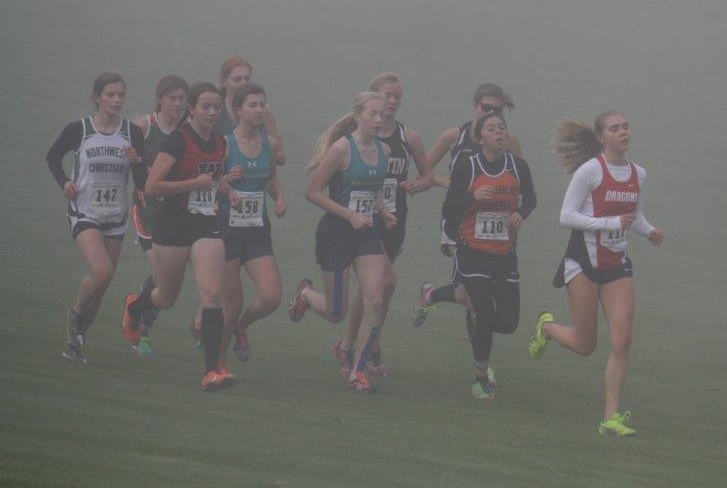
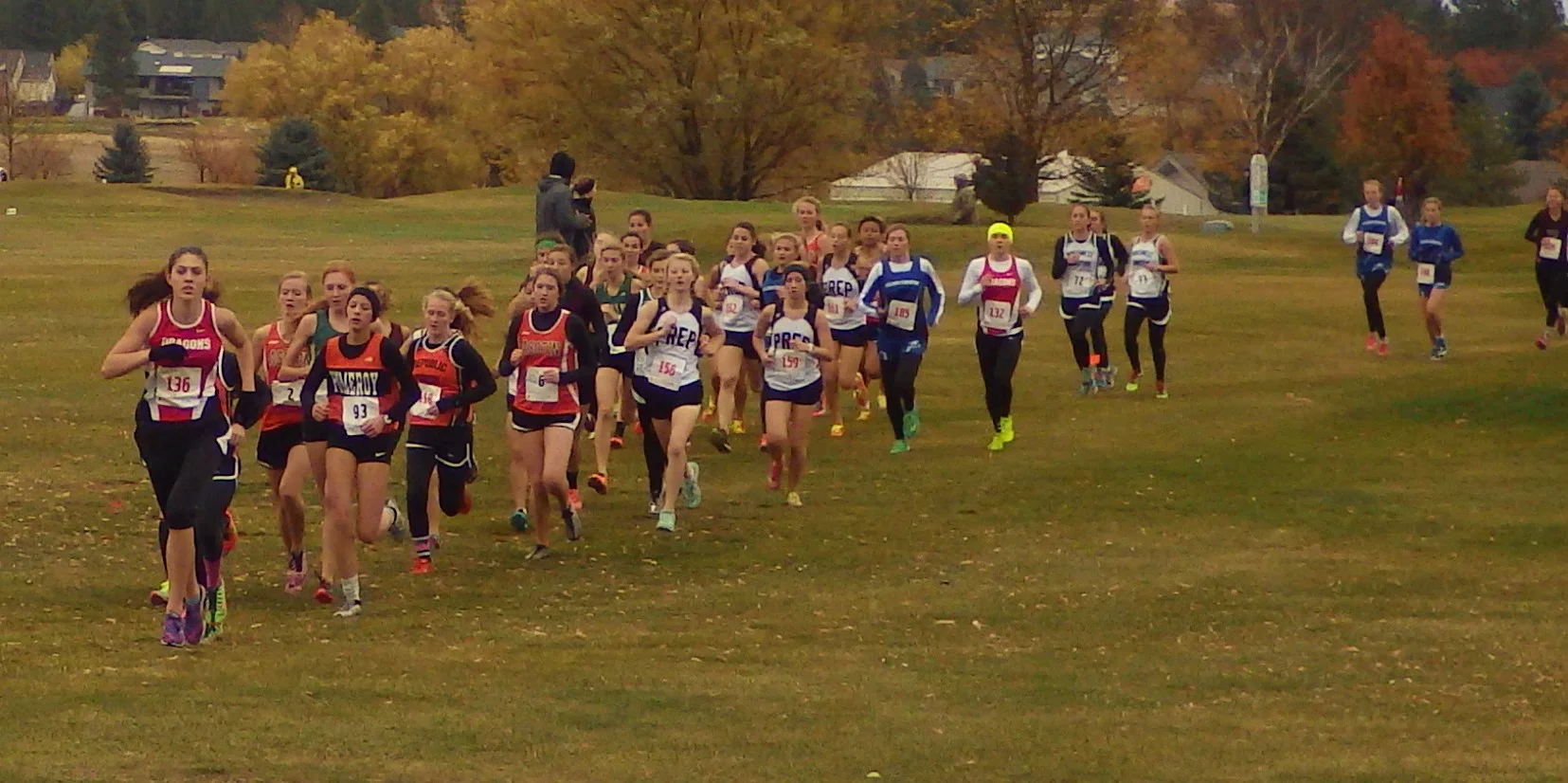
The race started on time and in a fog. Madison Ward and Marika Morelan, the very dynamic duo from St. George's, pulled into an early lead, with Shania Graham of Republic, Emily Adams of Waitsburg-Prescott, and the Asotin pair of Dykstra and Eggleston, Ellie Summers of Northwest Christian-Lacey, and Athena Milani of Liberty Bell.

I did a fast check. I thought Asotin was the youngest squad. Turns out, I was wrong. Liberty Bell brought six freshman to the meet.

Makayla Miller, yet another splendid freshman, and a pair of Northwest Christian-Colbert women paced out the next group, and then the main pack ran by. Ocosta put on a pretty display of team running and did a beautiful job of maintaining a pack.

By the halfway mark, the field thinned and the women headed out to no-man's-land at the back of the course where no one cheers and the sound of runners breathing and the footsteps next to you are all you have to anchor yourself to. Madie Ward (19:11) and Marika Morelan (19:15) ran wire-to-wire in the lead positions and never conceded an inch of ground.

Right to Left, to the best of my ability. Marika Morelan, Shania Graham, Maia Dykstra, Carmen Eggleston, Ellie Summers, Megan McSheffery, Anna Ruthven, Emily Adams, Athena Milani, Rebekah Henry. Photo courtesy of Suzy Cowdrey

Right to Left, to the best of my ability. Marika Morelan, Shania Graham, Maia Dykstra, Carmen Eggleston, Ellie Summers, Megan McSheffery, Anna Ruthven, Emily Adams, Athena Milani, Rebekah Henry. Photo courtesy of Suzy Cowdrey

The order at the top of the pack stayed relatively stable until just after the big hairpin turn just past the second mile mark. Maia Dykstra and Carmen Eggleston were still pacing each other, but on the descent from the green, Eggleston found another gear and went hunting for runners to take down. The last mile of the course, with its roller-coaster ride of never ending small hills, played to Eggleston's strengths. She may be the only Asotin runner ever to declare she loved the state course. Most just cuss it.

The team race, though, was decided down ticket, in the three, four, and five spots. Ocosta seniors Sararosa Gallo (21:09) and Rachel Saul (21:15) probably won the race for their team by running so strong together in the middle of the pack, while junior MacKenzie Ballo iced it with a 21:39.

In a surprise to the Asotin squad, Adrienne Washington, running in her first campaign and finally without a cast on her wrist, took third for the team. Her placement made the team race much closer, as did Katerina Stephenson's terrific kick that edged out the aforementioned Ballo. Samantha Nicholas took the fifth spot for Asotin. All the Asotin juniors ran PR's for the state course. Fun thought for the Panther partisans - Asotin is the only team in the top five that does not lose a graduating senior.

Northwest Christian-Lacey finished third among the teams, a position that they aren't used to. The eight-time defending champs finally had a slight down year, but what a terrific run they had. They'll be back and soon. 

Reardon was the fourth team on the podium. The team ran well, but in a field this fast, their pack running was not quite able to make difference in the standings. Still, the team graduates three seniors and it's nice to see these classy ladies get their shot on the stand.

DSC_0223.JPG

On to State - Recap of the District 7/9 1B/2B Meet

Flags should not fly sideways on race day

Flags should not fly sideways on race day

The weather for the District 7/9 regional meet in Spokane yesterday was, shall we say, crappy. Temperatures were in the low fifties. That wasn’t the issue. Wind, the bane of every runner, made itself one and carried with it some slashing rain for good measure. Since the golf course wasn’t available until 3PM (heaven forbid we get a location that will cater to the kids,) the meet didn’t start until the wind gathered itself as it always does in the afternoon in Eastern Washington.

 The course itself could have used more flagging as it wound around the tees and greens. With the recent rain, the footing could be charitably described as soggy, making for some slowish times from the runners.

Madie Ward, leading into the wind

Madie Ward, leading into the wind

Girls, as usual in Washington, ran first, which turned out to be to their advantage as the wind dipped for a few minutes right as the race started. Madie Ward of St. George’s led the pack out of the gates and onto the course. The leaders tried to stay packed up as long as they could to draft off the other runners. That pack included Madie, running mate Marika Morelan, Anna Ruthven of DeSales, the freshmen duo of Carmen Eggleston and Maia Dykstra of Asotin, freshman Makayla Miller of Pomeroy, Emily Adams of Waitsburg-Prescott, and Shania Graham of Reardon.  No real surprises as all these girls have been running well.

Picture Courtesy of Suzy Cowdrey and Madeline Eggelson

Picture Courtesy of Suzy Cowdrey and Madeline Eggelson

By two miles, the packs thinned to a ragged line of women. As they turned the corner for the final loop, they had a welcome chance to run in front of the wind. Ward and Morelan pulled into a solid lead, though Ruthven was eyeing them and staying in striking distance. Emily Adams, who’s been running with a ton of power for the last month looked to keep Ruthven close and fend off Asotin’s Dykstra.  Asotin’s other freshman standout was fighting her own battle.

The two have traded off the lead position on the team for the last four races, with Dykstra showing a definite affinity for relatively flat golf courses, and Eggleston loving the advantage that hills give her. It doesn’t affect the team scoring, but the weekly bragging rights matter, too.

The women rounded the last green with a three hundred meter descent to the finish line. For Madie Ward, this proved to almost be too far as she struggled to close out the race. For Madie, who always attacks the race aggressively, this qualified as a shock. According to the spectators at the line (I was up on the hill cheering the remaining competitors,) she began staggering and weaving a hundred meters from the finish and collapsing at the end, ultimately getting medical attention from the paramedics. I caught up with the St. George coaches and they relayed that they were worried but cautiously optimistic. All of us hope that this is a one-off event and that she’s back strong for the state meet next weekend.

In the meantime, Marika Morelan earned the regional title with Anna Ruthven pulling in second. Ward crossed in third with Emily Adams flying in behind her. Then came the Asotin freshmen with Eggleston out-legging Graham from Reardon by a second. Pomeroy’s Makayla Miller wasn’t ceding any ground either and was hot on their heels. A pair of ladies from Northwest Christian-Colbert, Rebekah Henry and Madison Janke, closed out the top ten.

Picture Courtesy of Suzy Cowdrey and Madeline Eggelson

Picture Courtesy of Suzy Cowdrey and Madeline Eggelson

The men’s race went a little more to the scripted form. Kenneth Rooks from College place took the overall title and heads to the state meet. Behind him, last year’s runner-up, NW-C’s Jack Ammon, repeated in second. There was a tough battle between Micah Henry (NW-C) and Thomas Weakland (Asotin). Nathan Vanos from St. George’s (and as hard a worker as you’ll see) took fifth. Tyler Shea helped cement the win for Northwest Christian-Colbert with his sixth place finish. DeSales Daniel Ness took seventh and will head to state as an individual qualifier, as with Rooks. Asotin’s Eli Engledow placed eighth, the only freshman to crack the top 30. Chris Oates of Wilbur-Creston and Nathan Hopkins of Davenport closed out the top ten.

Despite grabbing three of the top five team placements, the depth of the Asotin and St. George’s squads made themselves felt. The final scores, 73, 91, 99, should concern the NW-C team. To secure a spot on the podium, they need their last two runners to step up a bit.

For any of the men’s teams, they need everyone to step up if they’re going to beat Northwest Christian-Lacey, who hung a 16 in the District 4 meet.


I am offering a free Kindle copy of my second book, Trail of Second Chances, to anyone who promises to review it at Amazon or Goodreads. Just drop an email to thatguy@paulduffau.com

Are the great running magazines dying?

News broke this week that Marathon and Beyond will cease publication after it issues its December 2015 edition. The magazine occupied an interesting niche in the marketplace, opting for long-form articles that delved more deeply into the subject matter - whether it was a particular marathon or training story - than the quick blurbs that appear elsewhere.  The reason editor Richard Benyo offered was the transition in the readership from a print-based clientele to the digital consumer. While they still maintained a core of people who loved the magazine, the total numbers eroded year-by-year to the point where the magazine was no longer a viable business concern.

They aren't alone in feeling the pinch. Last year,  Running Times, my favorite magazine, announced that they were cutting their offering from ten issues per year to six. Even Runner's World is cutting, going from twelve to eleven this year.

To anyone watching the state of American newspapers, or the rise of indie publishing, this comes as no real surprise, though it is sad. The magazines, as with the newspapers, have yet to figure out how to fully monetize their content. Indeed, by publishing their content to the websites, often within days of the print version arriving at the subscriber's home, they actively devalue their business.

“We feel its [Marathon and Beyond] decline can be attributed to the move (especially among younger runners) to digital formats while at the same time the traditional long attention span of the running demographic has been undermined by new media,” Banyo wrote to Runner's World.

The digital formats share several things in common. First, and most importantly to the readers, it is free. Why should they wait for a print copy that they eventually will throw away, when they can have the same information, plus save ten bucks a year? Efforts at establishing firewalls work only when the content is so unique that readers willingly pay for it. In the case of the running mags, they don't have that quality. Much of the material that they publish is regurgitated from past issues. Want to know how to run a faster 5K? Google it (or Bing, which is what I use) and you get 18 million results. The best nutrition for a runner? 8 million, with two of the top ten linking to Runner's World articles. Which leads us to the second problem . . .

The internet is forever. All those articles will be there long after the magazines fail. In fact, it's fun to compare articles from five years ago to today's - the similarities are striking. When the magazines turned over subscriber bases, they did so on about a two year cycle, making it advantageous to rerun the same types of articles because the newest readers would not recognize the repetition. That's no longer the case.

Another part of the M&B statement interested me: that the attention span of the newest readers degraded to 140 characters. This leads to quick 250 words bits of fluff that do little more than announce a study or give a headline. At the websites, you can see the transition to this in the manner that they lay out the articles. A picture, a headline, one sentence of information. I would love to know the click-through rates.

None of this is good news for the running magazines (and they aren't alone.) For books, though, the dynamic is different. The disintermediation that is taking place makes it more advantageous to write books, especially those that approach the subject from a different angle.

Thus, we see more memoirs of runners appearing, from Nick Symmond's Life Outside the Oval Office to Rand Mitzner's Thirty-three Years of Running in Circles to Dave Clark's Out There. In Running: A Long-distance Love Affair, Shawn Hacking added the sound track to follow the story. JOCK: a memoir of the counter-culture, by Robert Coe, puts the history of the sixties into the context of his running career at Stanford.

Jack Welch put together a collection of his work from Running Magazine in When Running Was Young and So Were We, as we take a look back at the golden era of American running.

 There's always been a wealth of how-to's in running, but I wonder how much longer they will continue without any real changes in the underlying science. Some will continue to proliferate, mostly on the basis of athlete celebrity, but with the same information available for free, the need for them diminishes by the day.

In the fiction category, we see a little movement, too. There are, of course, my two books and more on the way. Bill Kenley put out High School Runner: Freshman. John Parker put out the wonderful Racing the Rain to complete the Quenton Cassidy saga.

While it looks bleak for the magazines, the future seems bright for authors of longer works. I've queried a dozen magazine for articles from Kenya, with no replies. While it would be nice to have a paying gig while I'm there, the raw material for the articles (there were about four different takes on Kenya that I wanted to explore) can still be used for a book or two. Plus the fiction that I'll generate from the trip.

I'm sad to see M&B go, but the running world will still have its own literature. It might be tweet length and book length with little in-between, but as long as there are runners who are also creators, we'll find a way to communicate.